
Agadir
A light, almost milky mist still clings to the masts of the boats in the marina as the first rays of sunlight pierce the horizon. The air is thick with that distinctive iodine humidity of the Souss-Massa coast, a blend o
Live reputation
Check our public profiles before booking.
Open source
Location
Why visit
A light, almost milky mist still clings to the masts of the boats in the marina as the first rays of sunlight pierce the horizon. The air is thick with that distinctive iodine humidity of the Souss-Massa coast, a blend o
- Beach and relaxation
- Surfing and water sports
- Marine gastronomy
- Hinterland hiking
Practical info
Good to know
Best period: March–June and September–November, 300+ sunny days a year
Daily budget: MAD 500–800 (€50–80) for a comfortable stay
Access: direct flights from major European cities to Agadir-Al Massira airport
Ideal duration: 7 days for beaches, Souk El Had, Paradise Valley and Taghazout
Quick read
Before you go
Useful cues
Best period: March–June and September–November, 300+ sunny days a year
Daily budget: MAD 500–800 (€50–80) for a comfortable stay
Access: direct flights from major European cities to Agadir-Al Massira airport
Destination guide
Agadir: the solar awakening between ocean and the foothills of the Atlas
A light, almost milky mist still clings to the masts of the boats in the marina as the first rays of sunlight pierce the horizon. The air is thick with that dis...
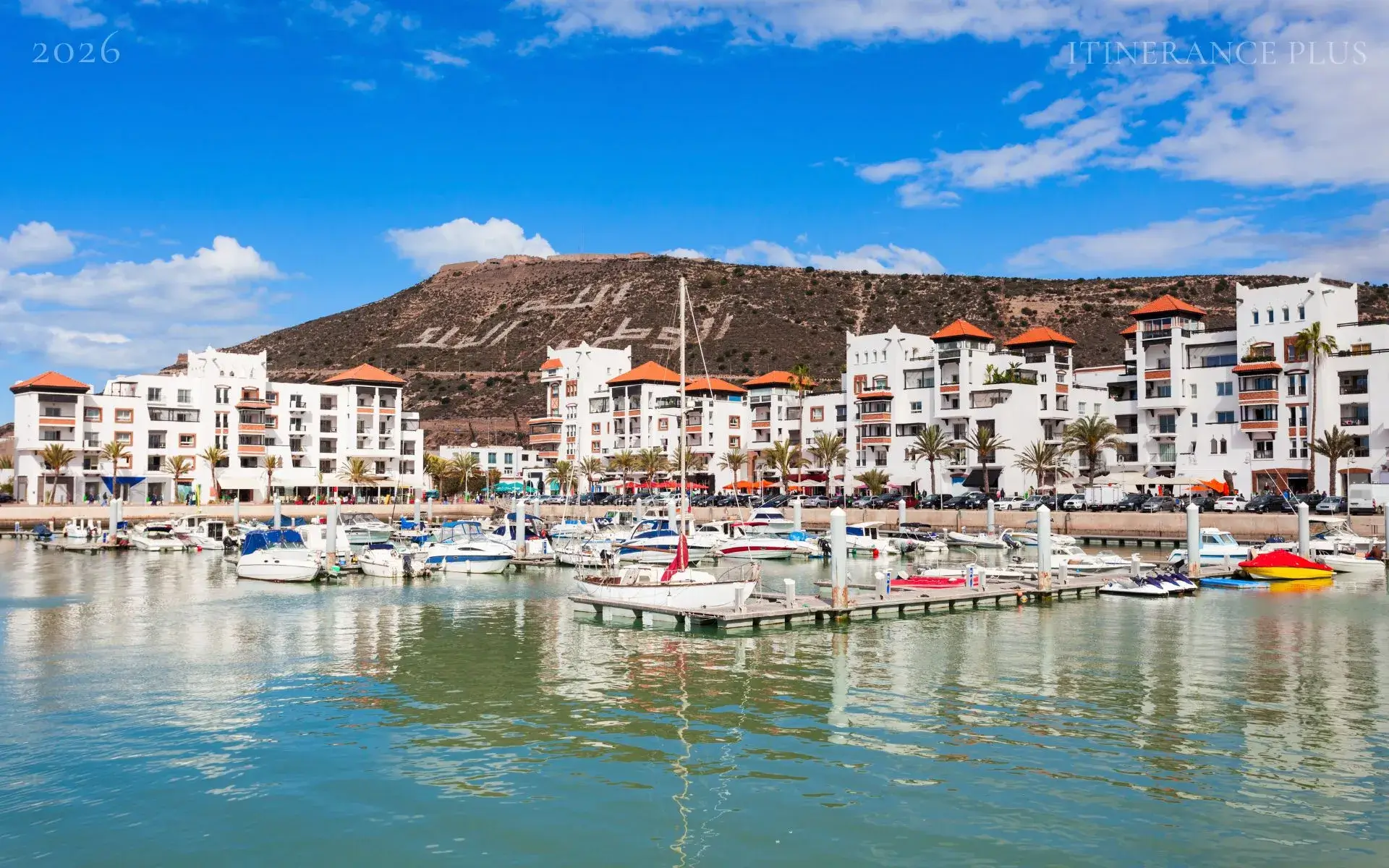
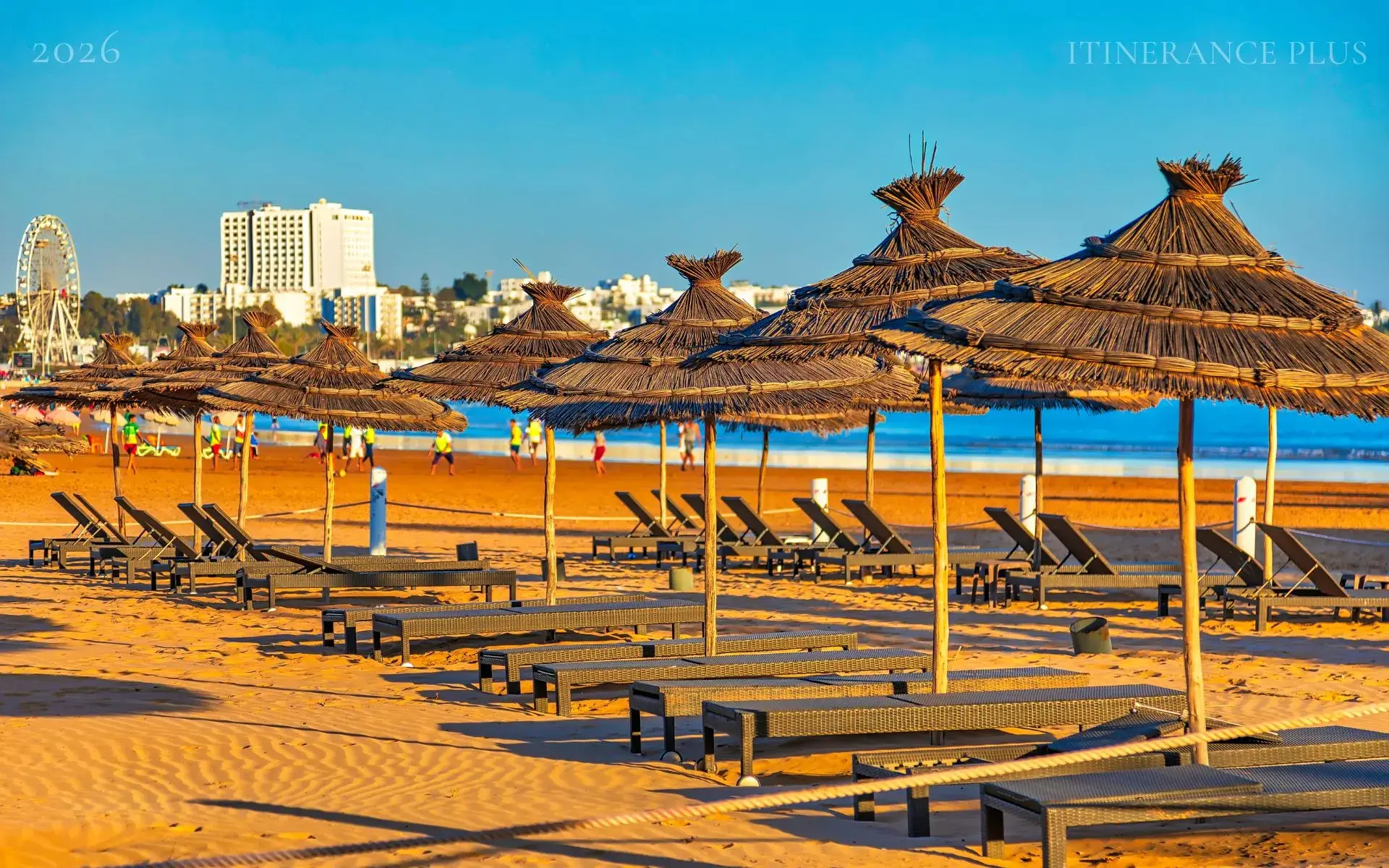
A light, almost milky mist still clings to the masts of the boats in the marina as the first rays of sunlight pierce the horizon. The air is thick with that distinctive iodine humidity of the Souss-Massa coast, a blend of sea salt and sun-baked earth. Walking along the corniche, you hear the rhythmic crunch of the fine sand beneath your feet, a golden carpet stretching for miles. Agadir is unlike any other Moroccan city; it doesn't hide behind ancient ramparts, but reveals itself entirely, bathed in constant light. The name Agadir here evokes a promise of tranquility, a city that has reinvented itself after the wounds of history to become a sanctuary of light and modernity.
You feel the sea breeze caress your face, carrying with it echoes of distant laughter and the deep rumble of the Atlantic. Here, the white concrete of modernist buildings converses with the azure sky, creating a clean, almost Californian aesthetic. People don't come to this coast to be trapped in the past, but to experience a certain idea of freedom, where the desert finally seems to find its solace in the waves. It's a place of gentle contrasts, where the scent of mint tea mingles with that of sunscreen, and where each evening transforms the bay into a painting of apricot and violet hues.
Agadir at a glance
Rebuilt after the 1960 earthquake, Morocco's leading Atlantic resort
10 km of fine sandy beach facing the Atlantic
300+ sunny days a year — a year-round destination
Gateway to the Souss hinterland: Paradise Valley, Taghazout, argan forests
Destination guide
How does the memory of Agadir survive at the top of the Kasbah?
To grasp the soul of this place, you must first gain some altitude and climb towards the ruins of the old citadel. Reaching the Oufella ridge, you find yourself...
To grasp the soul of this place, you must first gain some altitude and climb towards the ruins of the old citadel. Reaching the Oufella ridge, you find yourself face to face with the silent history of the region. The remaining stone walls are the guardians of a bygone era, before the 1960 earthquake shattered the city's destiny. The wind blows fiercely here, sweeping across the arid slopes where the national motto is inscribed in giant letters. The silence that reigns on these heights contrasts sharply with the bustling port that sprawls below. It is a place of necessary contemplation, a stone sentinel that reminds us that the strength of this land lies in its resilience.
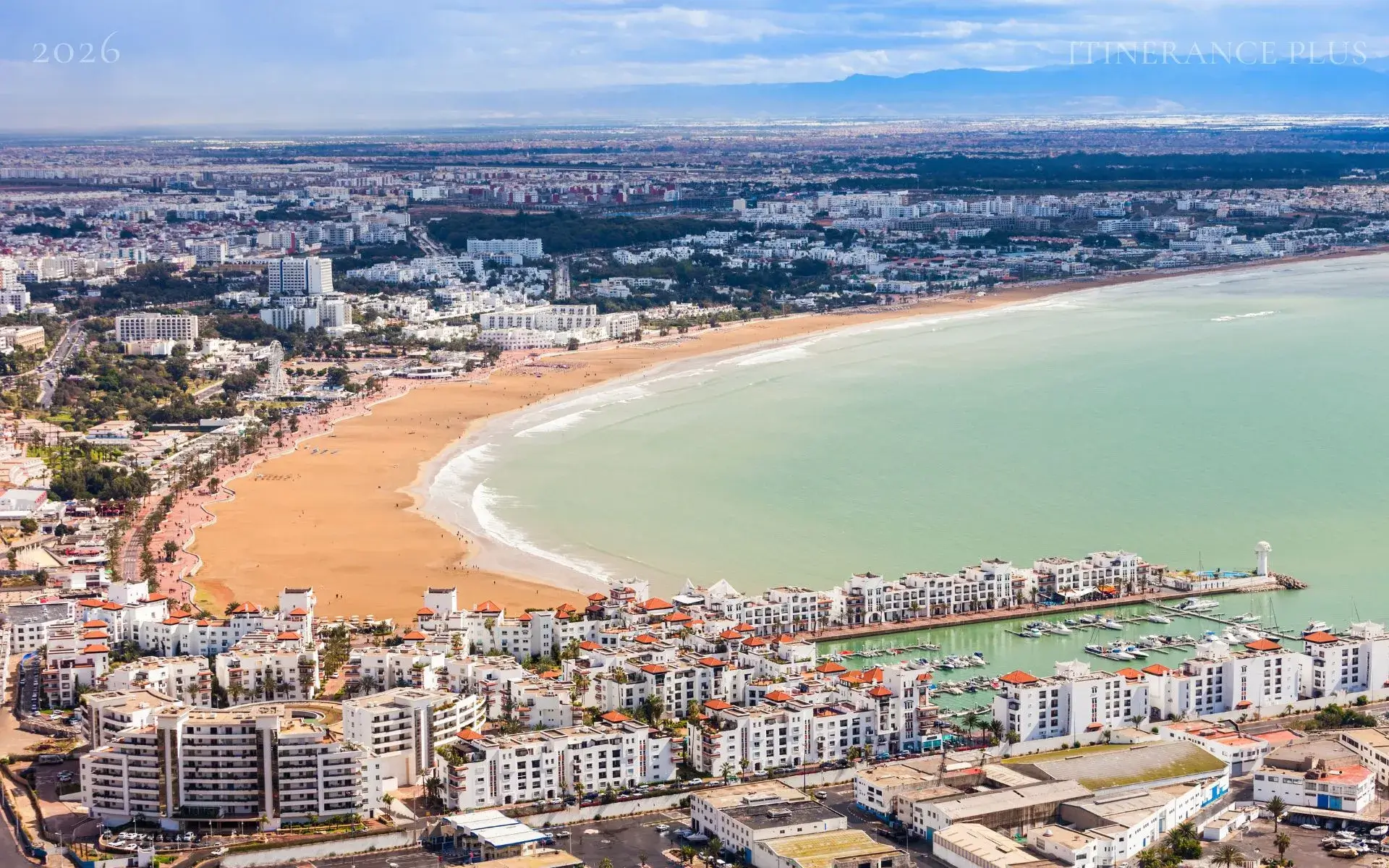
From this natural vantage point, the view encompasses the entire perfect curve of the bay. You watch the fishing boats coming and going, leaving trails of white foam on the cobalt water. The city's reconstruction followed a logic of broad, airy lines, creating a legible urban landscape that seems to breathe to the rhythm of the tides. Descending the dry slopes, the smell of hot asphalt replaces that of wild grasses. In just a few minutes, you go from a world of ruins to a dynamic metropolis. It is this duality that defines the character of the resort: a discreet yet powerful historical foundation upon which a new life has been built, resolutely turned towards the future and the open sea.
Walking along the hillside paths, you encounter locals who come here to meditate or simply contemplate the sunset. There's no hustle and bustle, only a profound respect for this landscape that has witnessed so much. The late afternoon light sculpts the contours of the Atlas Mountains in the background, creating layers of increasingly pale blue. You then understand that Agadir is not just a beach, but a gateway to a complex geography, a point of equilibrium between the ruggedness of the mountains and the fluidity of the ocean. It's a visual experience that puts things into perspective, between human fragility and the immutability of nature.
Kasbah Oufella — practical info
Free entry, accessible on foot or by taxi (MAD 10–15) from the centre
Panoramic view over the entire bay and royal motto visible from the sea
Best light: late afternoon, 1 hour before sunset
Allow 30 min to 1 hour for the visit
Destination guide
Why is the Souk El Had the true heart of local life?
Leaving the coast and venturing into the Abattoir district to reach the gates of Souk El Had is like plunging into a world of raw sensations. This isn't a marke...
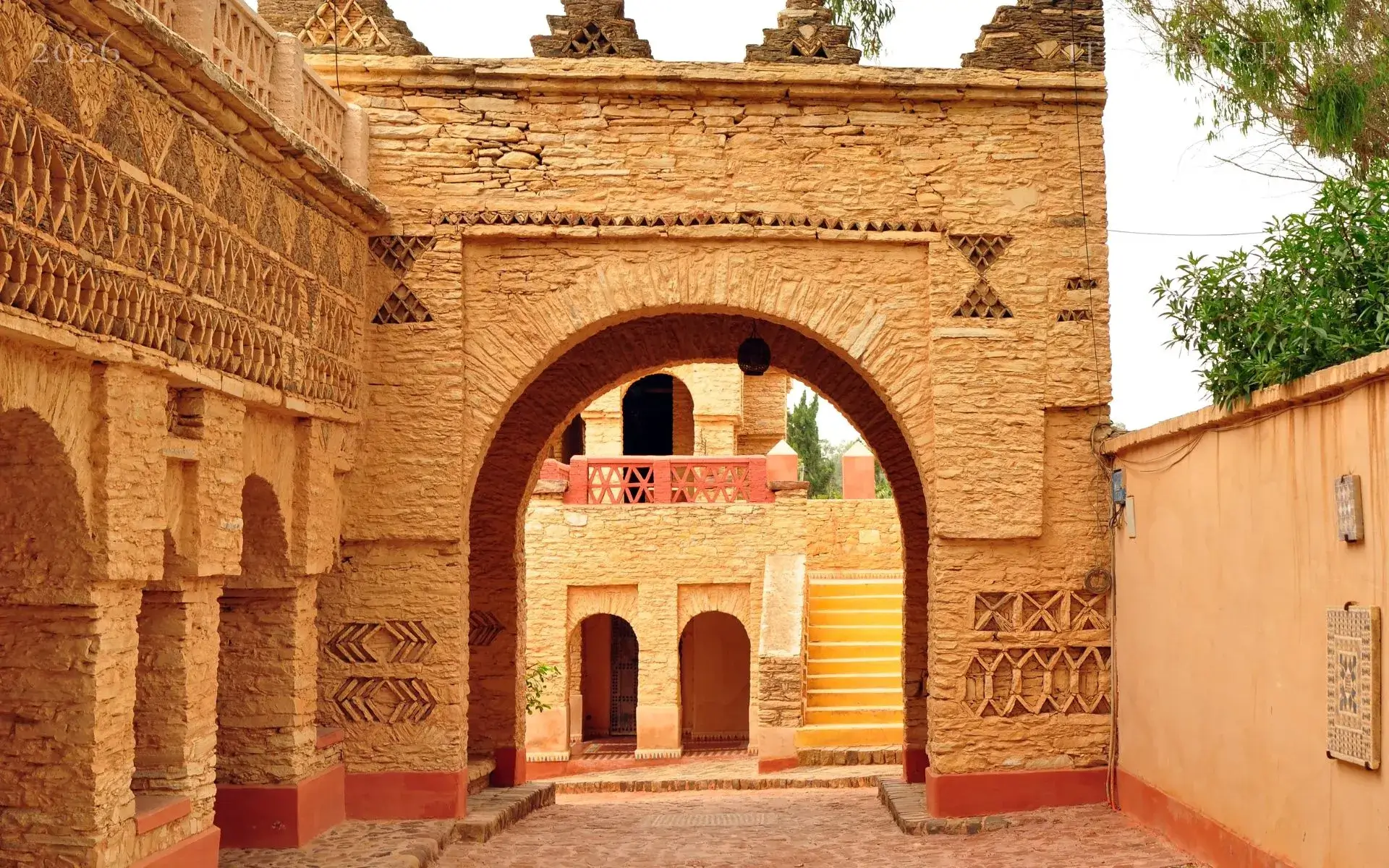
Leaving the coast and venturing into the Abattoir district to reach the gates of Souk El Had is like plunging into a world of raw sensations. This isn't a market for show, but a city within a city, protected by high ochre walls pierced by twelve monumental gates. As soon as you cross the threshold, your nostrils are assaulted by a complex blend: the spiciness of chili peppers, the sweetness of cinnamon, the bitterness of tanned leather, and the freshness of cut grass. This is where the economic and social heart of the region beats. The stalls overflow with produce from the Souss region: pyramids of vibrant oranges, mountains of juicy tomatoes, and bags of henna with its fine powder texture.
The noise is constant, an organized cacophony where vendors' calls mingle with the clatter of carts and lively discussions about the price per kilogram of saffron. You wander through the specialized aisles, moving from the olive section, where dozens of varieties gleam under bare bulbs, to the thuya wood artisans' area. Here, you don't just buy, you trade. The merchants invite you to touch the fabrics, to smell the essential oils of argan, this local treasure produced in the hinterland. Culinary argan oil, with its roasted hazelnut flavor, is everywhere, offered in simple bottles, a far cry from the sophisticated packaging of luxury boutiques.
You have to deliberately lose yourself in the labyrinthine souk to discover the most authentic shops. There you'll find blacksmiths hammering iron with age-old precision and herbalists concocting remedies from mysterious roots. It's an immersion in a craft that resists standardization. Lunch there is a sensory must: a simple harira soup or a meat tagine with prunes enjoyed at a corner of a wooden table. The food here has a taste of the land, an authenticity that you won't find on the touristy waterfront. This is where the city reveals itself unvarnished, in its generosity and boundless energy.
As the day progresses, the souk's intensity doesn't diminish. Families come to stock up for the week, children dart between the legs of passersby, and porters weave their wares with disconcerting agility. It's a complete spectacle that engages every sense. You leave this enclosed space feeling slightly dizzy, arms laden with packages and minds filled with colorful images. Souk El Had is much more than a market; it's a repository of Moroccan popular culture, a place where the traditions of the Atlas Mountains mingle with urban modernity in a whirlwind of uninterrupted life.
Souk El Had — practical info
Open 6 days/week (closed Monday), 12 monumental gates
Specialist sections: food, crafts, natural cosmetics
Lunch on-site recommended: harira or tagine, great value
Go early morning in summer to avoid the heat
To experience
How does Paradise Valley offer a refuge for nature lovers?
Just a few dozen kilometers from the beaches of Agadir, the landscape transforms dramatically. Taking the winding road towards Imouzzer, you enter Paradise Vall...
Just a few dozen kilometers from the beaches of Agadir, the landscape transforms dramatically. Taking the winding road towards Imouzzer, you enter Paradise Valley, a name that seems to have been whispered by travelers in the 1970s in search of the absolute. Here, water has carved natural pools into the dazzling white limestone, creating oases of coolness amidst arid vegetation. The contrast is striking: the deep green of the palm trees and oleanders stands out sharply against the azure sky and the ochre of the rock faces. It is a mineral sanctuary where time seems to have stood still.
The hiking trail follows the river, sometimes requiring you to hop from stone to stone to cross. You can hear the murmur of the water cascading in small waterfalls, a soothing sound that replaces the crashing ocean waves. Local youths defy gravity by diving from the high cliffs into the deep pools, their shouts of joy echoing against the stone walls. You can settle down on a sun-warmed slab and let your feet soak in the cool water, watching the dragonflies dance on the surface. The feeling of disconnection is complete, just a stone's throw from the urban bustle.
This valley is also a haven for honey and almond trees. In spring, blossoming trees dot the landscape with white and pink hues, releasing a delicate fragrance. Local beekeepers sell their wares by the roadside: thyme, euphorbia, or mountain flower honeys, each embodying the very essence of this preserved terroir. It's a land of Berber tradition, where hospitality is more than just a word. Stop at a small roadside café to savor a tagine cooked over a wood fire, its flavors intensified by the purity of the air. It's an experience of simplicity that brings you back to what truly matters.
As the day draws to a close, and the light fades and shadows lengthen in the canyon, Paradise Valley takes on an almost mystical dimension. The rocks glow a deep red, and the silence grows ever more profound. It's the perfect time to begin the return journey to the coast, carrying with you the coolness of the springs and the serenity of the mountains. This excursion is essential for understanding the region's geographical diversity. It serves as a reminder that this coastal town is inseparable from its mountainous hinterland, a hidden gem that offers a perfect counterpoint to the vast ocean.
Paradise Valley — practical info
40 km from Agadir, towards Imouzzer (45 min to 1h drive)
Swimming in natural pools possible from March to October
Bring walking shoes, swimwear and a picnic
Can be combined with local honey and amlou tasting
Flavors
What are the seafood flavors that define the cuisine of the region?
The cuisine in this part of Morocco is intrinsically linked to the bounty of the Atlantic. The city's fishing port, one of the country's largest, unloads tons o...
The cuisine in this part of Morocco is intrinsically linked to the bounty of the Atlantic. The city's fishing port, one of the country's largest, unloads tons of fish and shellfish every morning, which end up on plates a few hours later. Sardines are the discreet yet ever-present star here. Simply grilled over a wood fire, with a pinch of coarse salt and a drizzle of olive oil, they offer a uniquely intense flavor experience. Their rich, briny flesh melts in the mouth, evoking the authentic meals of fishermen. They are often enjoyed on the go, near the port, in an atmosphere of utter simplicity.
But local cuisine can also be more sophisticated. The monkfish or conger eel tagine, prepared with preserved lemons and local olives, is a marvel of balance between acidity and sweetness. Spices, such as ginger and turmeric, enhance the delicate texture of the fish without ever overpowering it. You must also try the fried calamari and king prawns, whose crispy texture belies their impeccable freshness. Here, the product reigns supreme, and the chefs strive to respect its natural state. Each meal is a celebration of the sea, a dialogue between the ocean's bounty and the skill of the hands that transform it.
Another staple of the Souss region is the famous amlou. This creamy spread, a blend of mountain honey, ground roasted almonds, and argan oil, is a true energy booster. It's enjoyed at breakfast with warm bread fresh from the traditional oven. It's an unforgettable flavor, a nutty, earthy taste that perfectly encapsulates the region's identity. Amlou is much more than a treat; it's a symbol of local hospitality, often offered to guests as a welcome. Tasting it allows you to experience the richness of this ecosystem where the argan tree reigns supreme.
In the evening, along the waterfront promenade, restaurants offer seafood platters as the sun sets. It's the perfect time to savor Dakhla oysters or spider crabs, accompanied by a crisp Moroccan salad. The freshness of the ingredients, combined with the mild climate, makes every dinner memorable. It often ends with mint tea, served with a high, precise gesture that creates a light foam on the surface. The cuisine here doesn't try to impress with artifice; it convinces with the quality of its ingredients and the authenticity of its flavors. It's a gastronomy of immediate pleasure, wholesome and vibrant.
Gastronomy — must-tries
Grilled sardines at the port between 7am and 11am
Amlou (honey + almonds + argan oil) at breakfast
Seafood on a promenade terrace: book the day before in high season
Port market for morning catches
Destination guide
How does Agadir’s urban rebirth describe its future?
The city you see today was shaped by a deliberate modern vision after the 1960 tragedy.
The city you are exploring today is the product of a bold architectural vision born after the tragedy of 1960. Instead of rebuilding exactly as it was, the architects of the time, under the impetus of King Mohammed V, opted for modernity. This gave rise to districts like the Tourist Sector and the City Center, characterized by buildings with clean, geometric forms, wide avenues, and numerous green spaces. It is an urbanism of light, where white dominates to reflect the heat and attract brightness. Walking through these districts is like discovering an open-air museum of modernist architecture from the 1960s and 70s, a style that is now making a comeback on the world stage.
Destination guide
Agadir, a perpetual invitation
A white city facing the azure sky and Atlantic light.
Agadir does not seduce through labyrinths or nostalgia. It convinces through space, air, sea light and a calmer rhythm of life. That is exactly why it stays with travelers: it offers a different Morocco, built on resilience, openness and the feeling that the horizon is still ahead.
Frequently asked questions
Everything about Agadir
Yes, 3 hours by road (250 km) or 1 hour by flight. The route crosses the Tizi n'Test pass with stunning scenery. Several bus companies run the route.
Experiences to prioritize
The strongest options for this destination
Destination guide
Go further from this destination
Once the destination is clear, the next useful step is to choose the pace, comfort level and experiences that truly fit the trip you want.
Destination guides
Other destinations to explore
These complementary destinations help compare different travel atmospheres and refine the route.
