Back to Marrakech
Palace
Bahia Palace: drifting between shadow and light
Before visiting
Key takeThe scent of blooming jasmine clings to the stucco arcades, an olfactory caress that surprises you as soon as you pass through the first low doorway.
In this labyrinth of stone and cedar, the bustle of the Mellah fades away, replaced by the muted slide of soles across terracotta mosaics. You feel the damp coolness of marble basins, a blessing as the Marrakech sun begins to bite into the dust of the lanes.
The Bahia Palace does not reveal itself all at once; it unfolds like a whispered conversation between a grand vizier and his dreams of grandeur.
Here, the eye is constantly drawn by the finesse of turquoise zellige or the depth of a painted wooden ceiling, where every motif seems to tell a silent epic.
You do not visit this residence for strict architectural order, but for its poetic disorder, its mixture of secret patios and lush gardens forming a maze of pure Moroccan beauty.
As you move forward, the light changes, shifting from the blinding glare of the large courtyards to the protective shade of private alcoves, revealing the “Beautiful One”, the favorite who gave this timeless place its name.
Location
Insight
First impressions
The scent of blooming jasmine clings to the stucco arcades, an olfactory caress that surprises you as soon as you pass through the first low doorway.
In this labyrinth of stone and cedar, the bustle of the Mellah fades away, replaced by the muted slide of soles across terracotta mosaics. You feel the damp coolness of marble basins, a blessing as the Marrakech sun begins to bite into the dust of the lanes.
The Bahia Palace does not reveal itself all at once; it unfolds like a whispered conversation between a grand vizier and his dreams of grandeur.
Here, the eye is constantly drawn by the finesse of turquoise zellige or the depth of a painted wooden ceiling, where every motif seems to tell a silent epic.
You do not visit this residence for strict architectural order, but for its poetic disorder, its mixture of secret patios and lush gardens forming a maze of pure Moroccan beauty.
As you move forward, the light changes, shifting from the blinding glare of the large courtyards to the protective shade of private alcoves, revealing the “Beautiful One”, the favorite who gave this timeless place its name.
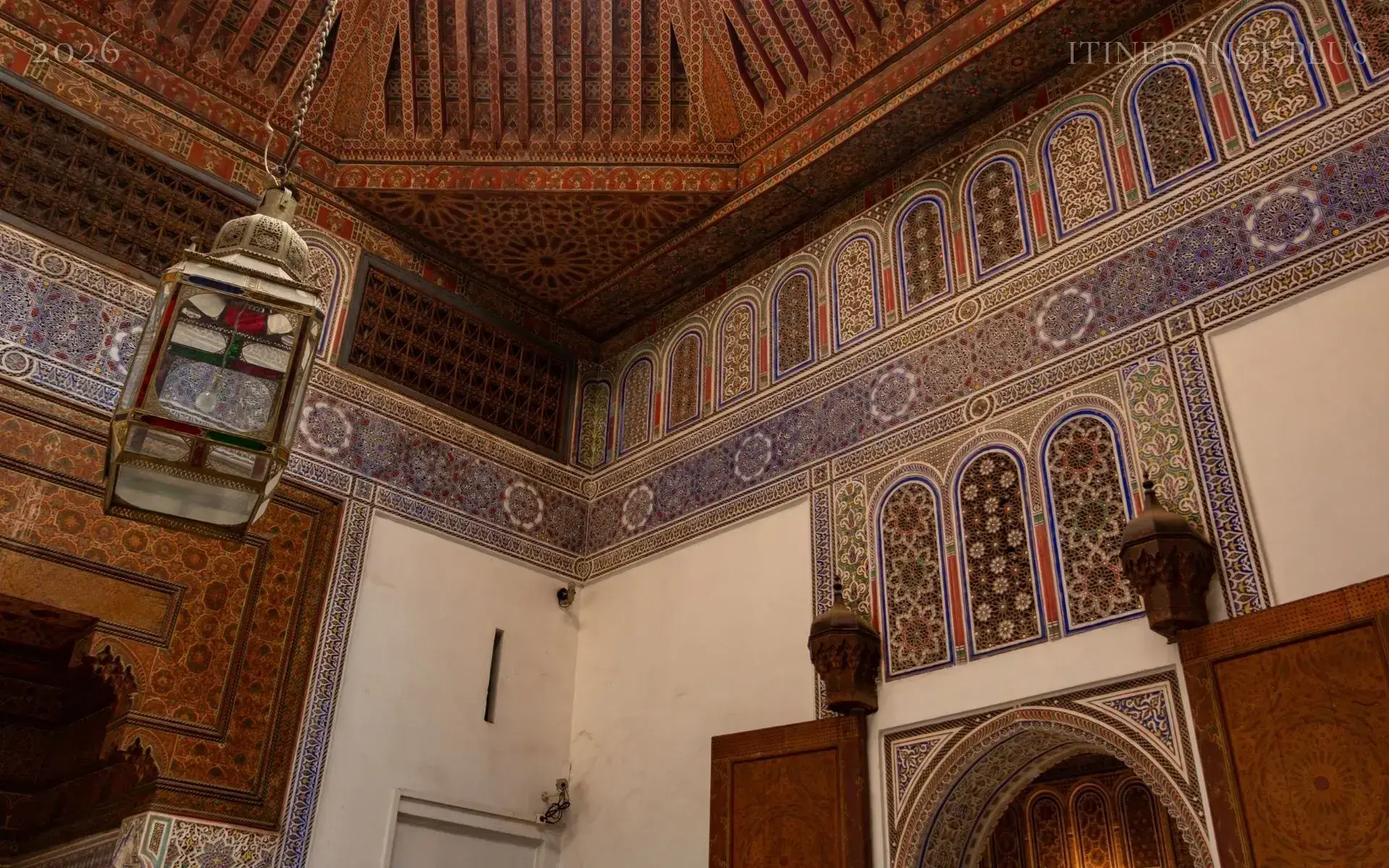
Architecture
Why does this marble labyrinth defy the laws of geometry?
If you are looking for the perfect symmetry of European castles, this place will disorient you.
The Bahia Palace is a living organism that grew organically, almost wildly, according to the ambitions and whims of its successive owners, Si Moussa and then his son Ba Ahmed.
Each new land acquisition led to the construction of a new wing, a new patio, without any predetermined overall plan. It is precisely this lack of rigidity that gives the place its magnetic charm.
You move from a small intimate room to a monumental courtyard without transition, as if crossing the different layers of a life of power. This irregularity creates a feeling of constant discovery, a surprise at every turn of the corridor.
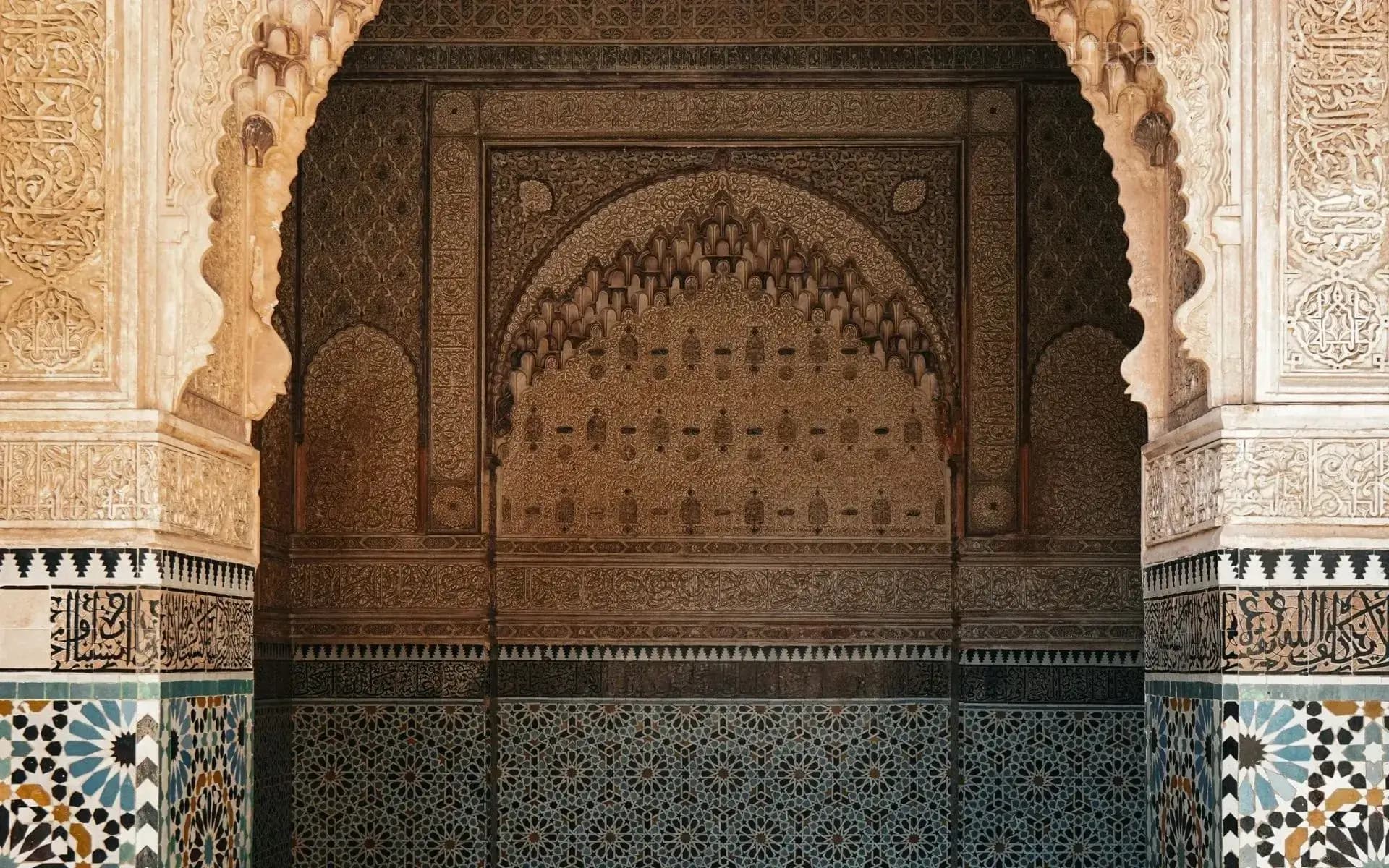
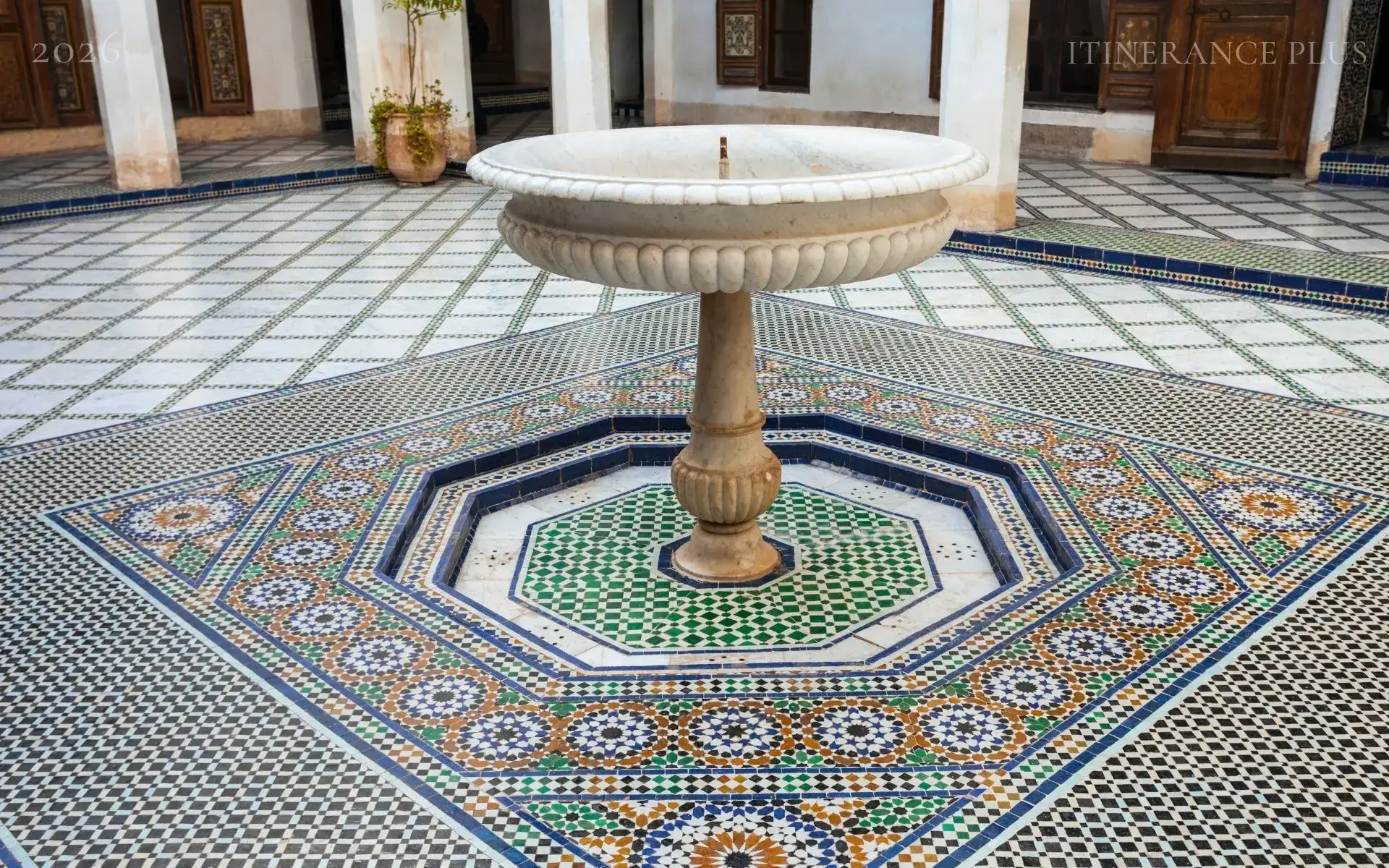
The materials used bear witness to craftsmanship with no apparent budget limit. Carrara marble stands beside cedar wood from the Middle Atlas, while zellige from Fez draws eternal carpets across floors and walls.
You will notice that the ceilings are especially elaborate, some using the zouak technique, a form of wood painting made with natural pigments. Madder red, cobalt blue and saffron yellow intertwine to form artificial skies of fascinating complexity.
In this residence, luxury does not lie in massive ostentation, but in the infinite repetition of detail, in the precision of a plaster carver who may have spent months chiseling a single horseshoe arch.
This architecture “by ear” also allows for ingenious climate management. The patios act as wells of coolness, capturing night air and releasing it during the day.
Openings are calculated to prevent direct sunlight while bathing the rooms in soft clarity. As you walk through the galleries, you feel that light current of air, the breathing of the building that makes the Marrakech heat bearable.
It is a lesson in vernacular urbanism where comfort does not depend on technology, but on the intelligence of the layout and the nobility of natural materials.
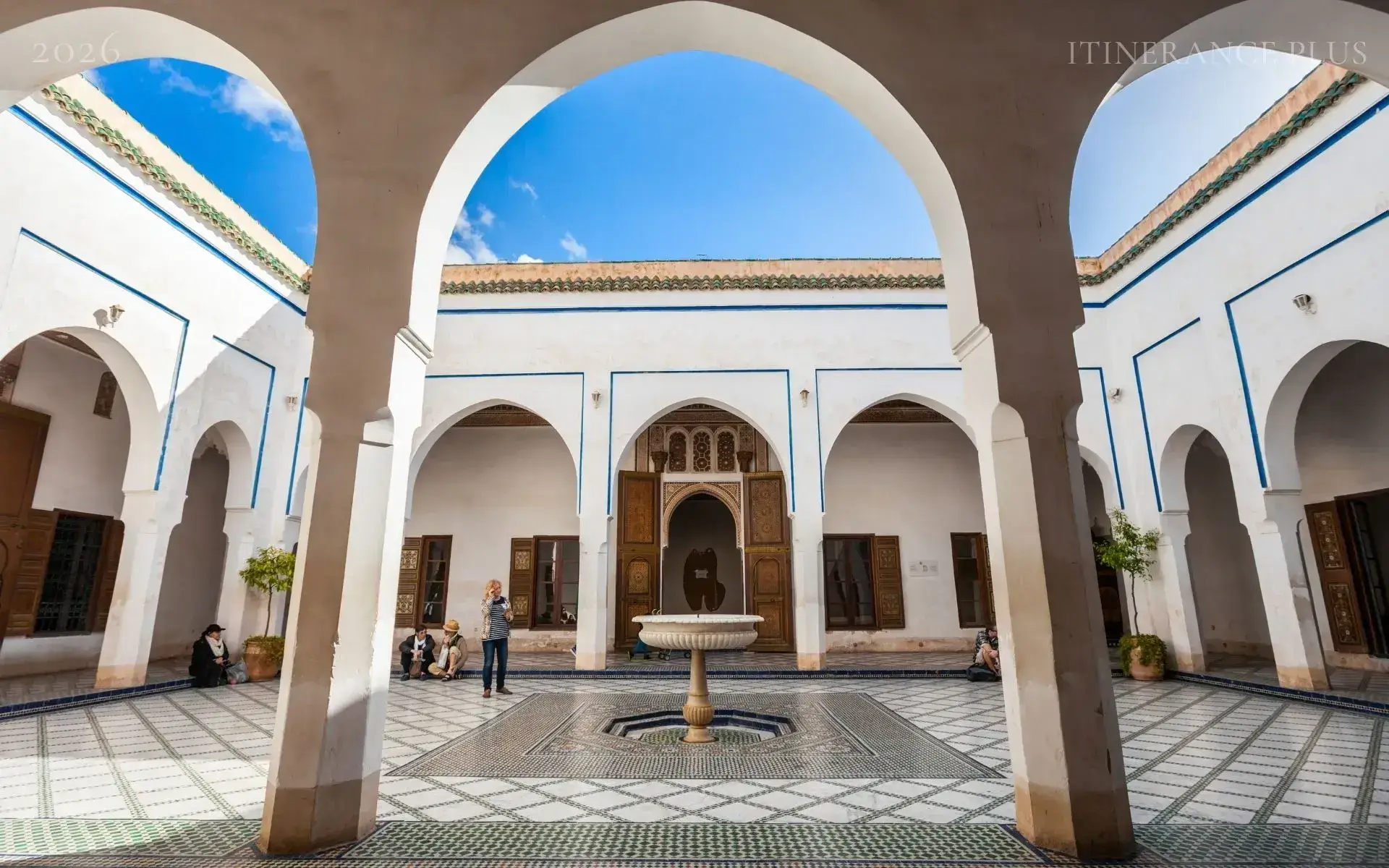
Insight
How does the Grand Court of Honor capture the vastness of the sky?
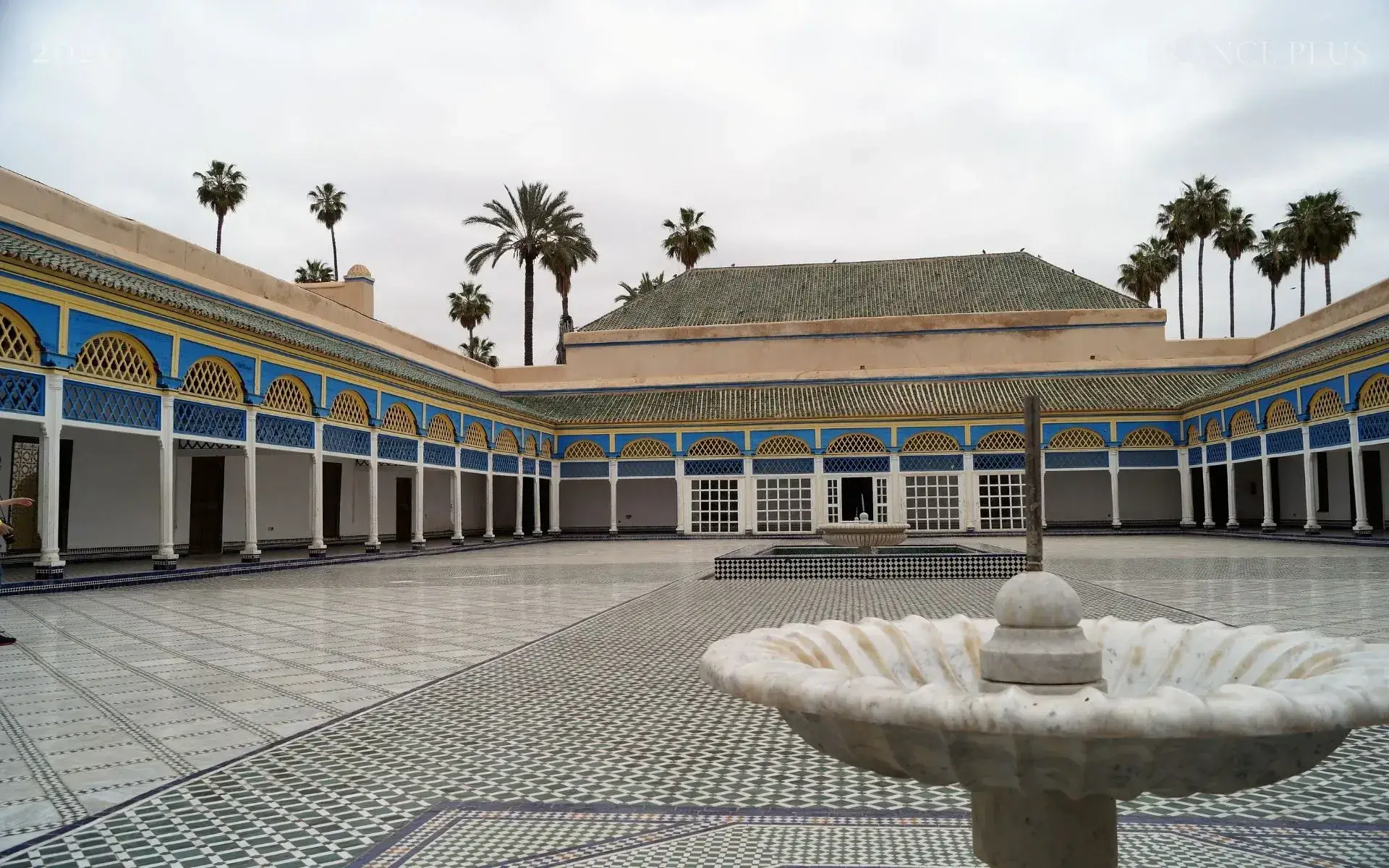
The transition is abrupt: after crossing dark and narrow rooms, you suddenly emerge into the immensity of the Court of Honor. This is the high point of the Bahia Palace, a 1,500 square meter space entirely paved with marble and colored zellige.
Here, the sky becomes the true ceiling of the residence. The dazzle is total. The sun reflecting on the white ground forces you to narrow your eyes, while the silence, broken only by the cry of a passing bird, gives the place a sacred dimension.
You can imagine grand receptions, the rustle of silks and the scent of incense floating beneath the covered galleries surrounding this esplanade.
The painted wooden columns supporting the arcades bring a touch of lightness to this mineral ensemble. Their ochre and green tones echo the shades of the floor mosaics, creating a perfect chromatic balance.
At the center, marble fountains, once flowing, recall the sacred importance of water in Moroccan culture. Water was not only decorative; it was the symbol of life and purity, the ultimate luxury in a city bordered by arid lands.
Sitting for a moment beneath the galleries, you can watch clouds reflected on the polished paving, an image of absolute serenity.
This courtyard was not only a place of representation; it also linked the different parts of the harem and the vizier’s private apartments. It is a fluid circulation space where interior and exterior merge.
The structure of the courtyard itself invites contemplation. Every detail of the stucco frieze running along the walls deserves your attention; geometric and floral motifs repeat without ever tiring the eye.
It is in this magnificent void that one best grasps the soul of this city, its ability to create oases of calm and light within the urban chaos of the Medina.
Gardens
What secrets do the inner gardens protect from the outside world?
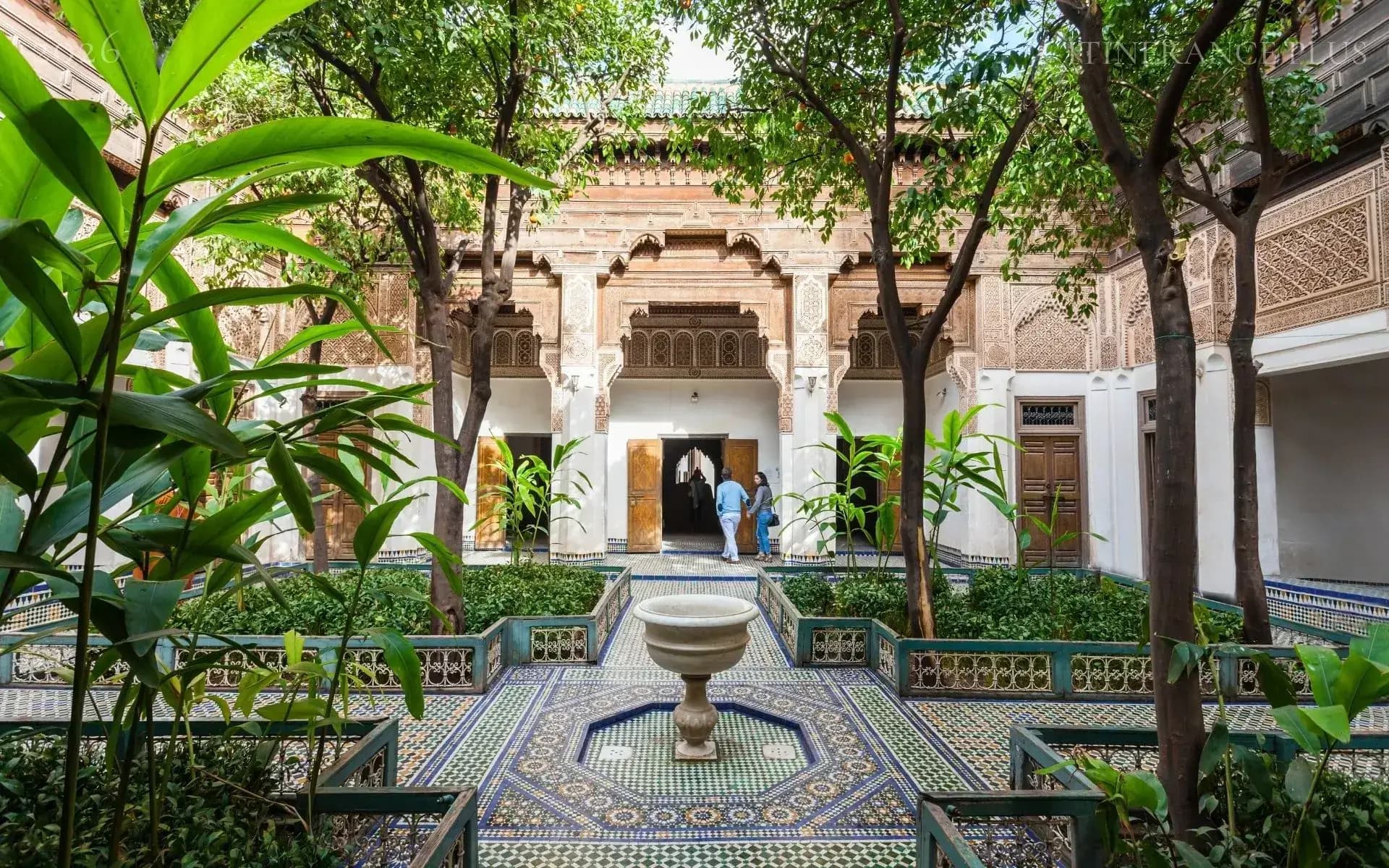
Behind the thick walls of the Bahia Palace, nature is not merely present, it is staged. The gardens, or riads, are conceived as earthly representations of paradise.
Entering the garden of the Petit Riad, you are struck by the change in temperature. Orange trees, lemon trees and banana trees form a dense canopy that filters the sun’s rays, creating a muted, almost green light.
The smell here is heavier, sweeter, loaded with moisture and sap. It is an enclosed space where time seems to have stopped at the end of the nineteenth century, far from engines and the fervor of the souks.
The arrangement of the planting follows the traditional cross-shaped plan, divided by paths paved with zellige. This layout allows for optimal irrigation while making circulation easier.
You will notice that trees are often planted below the level of the paths, a technique that preserves moisture at the roots and keeps fruit within easy reach. The gardens are not only aesthetic; they are nourishing.
Cypresses add a vertical note, pointing toward the sky like vegetal minarets, while roses and hibiscus add vivid touches of color against the emerald green of the foliage.
These gardens were once the favored places for the social life of the harem. The vizier’s favorites came here to find a little freedom, protected from indiscreet eyes.
You can still imagine whispered conversations near the fountains, the sound of slippers on glazed tiles and children playing between palm trunks. The enclosure of these green spaces reinforces the feeling of exclusivity.
It is a luxury to possess such a domesticated jungle in the heart of Marrakech.
If you stand still for a few minutes in one of these planted courtyards, you will eventually hear the song of garden bulbuls, small birds with melodic calls that have made this green refuge their home.
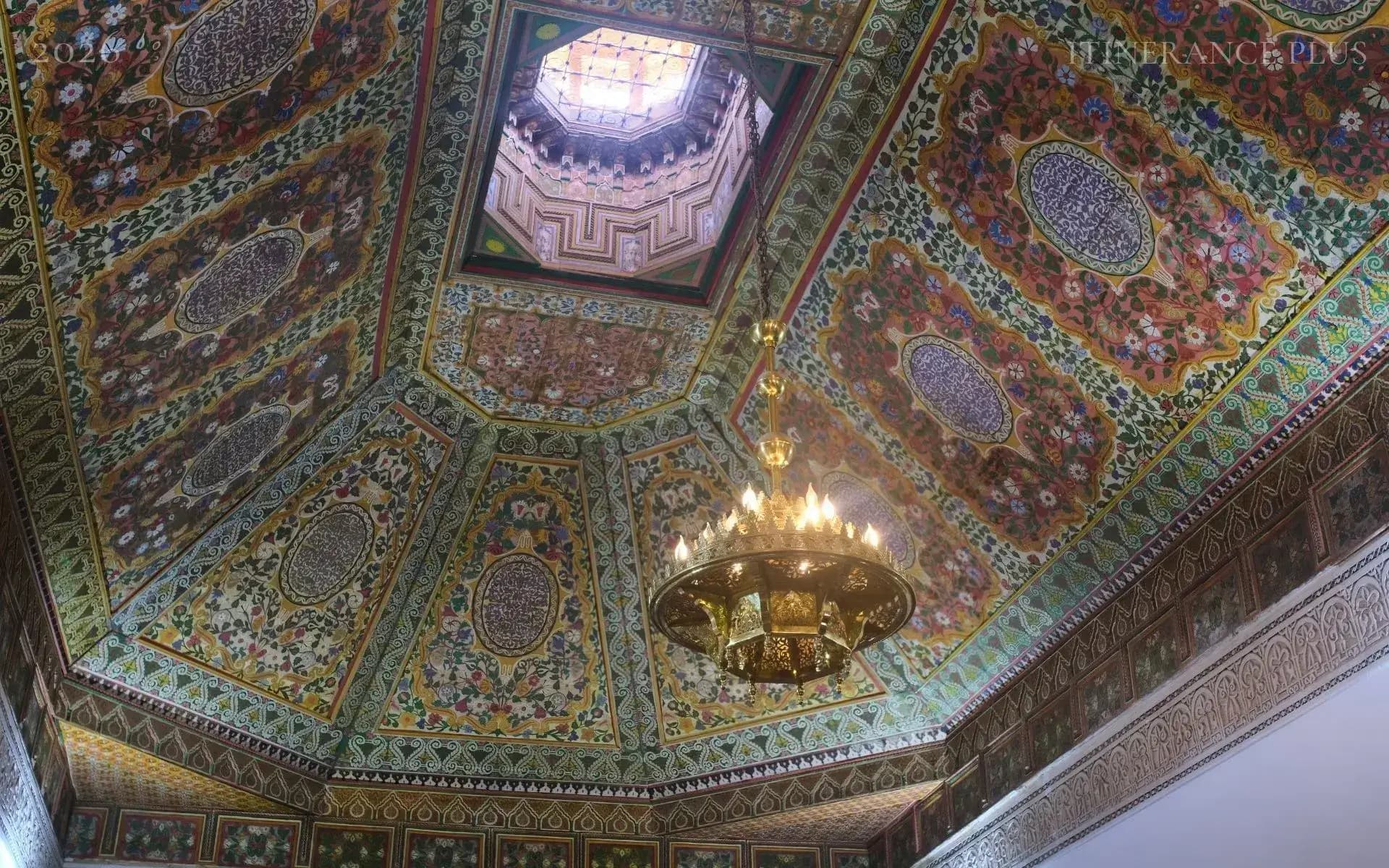
Craft
How does carved wood craftsmanship elevate the ceilings?
One of the most striking aspects of the visit lies above your head. The ceilings of the Bahia Palace are among the finest examples of artistic woodwork in Morocco.
Cedar, a noble and rot-resistant wood, was worked with a precision that commands admiration.
In the Council Room, the domed ceiling is a true technical achievement: thousands of pieces of wood fit together without a single nail, forming stellar patterns of mathematical complexity.
The paint decorating these structures, made with egg yolk and mineral pigments, has retained a surprising vividness despite the weight of the years.
You will also discover the work of moucharabieh, those finely openwork wooden screens that allow one to see without being seen. Used for windows and balconies, they filter light by projecting lace-like shadows onto marble floors.
It is an art of suggestion and concealment, so characteristic of Moroccan architecture. Cedar wood also releases a persistent, slightly resinous scent that permeates the oldest rooms.
This olfactory signature accompanies your route, adding an extra sensory dimension to the visual beauty of the decorations.
The monumental doors are no less impressive. Massive, often reinforced with wrought-iron studs, they are adorned with geometric carvings recalling the motifs of Berber carpets.
Looking at the frames, you will notice poetic verses or religious maxims calligraphed with rare elegance. Wood is not only a construction material here;
it is a canvas on which artisans projected their dreams of perfection. Every beam and every carved bracket contributes to the atmosphere of nobility reigning in these rooms, reminding you that the human hand can transform raw matter into an architectural poem.
Insight
Why is the Mellah the perfect setting for this palace?
The Bahia Palace does not exist in isolation; it is rooted in one of the most vibrant and historically charged districts of Marrakech: the Mellah.
The city’s former Jewish quarter, with its narrower streets and wooden balconies opening outward, unlike traditional Arab houses turned inward, offers a striking contrast with the serene majesty of the vizier’s residence.
As you leave the monument, you are immediately plunged back into intense neighborhood life. The smells of fresh mint, freshly ground spices and wood-fired bread rush toward you, creating an immediate sensory shock.
Walking through the Mellah after visiting the palace helps you understand the complexity of Moroccan society at the time. The vizier chose this district for its proximity to the Royal Palace, Dar el-Makhzen, but also for its commercial energy.
Today, the Mellah souks are known for fabrics, silver jewelry and herbalists. You can willingly lose yourself there, observing artisans still working according to centuries-old methods.
It is a district of labor and daily life that gives full depth to the silent luxury of the residence you have just left.
The spice market on Place des Ferblantiers, only a few steps away, is an essential passage. Mountains of paprika, cumin and ras el hanout form a colorful tableau that echoes the palace zellige.
You can drink mint tea on a terrace overlooking the ramparts, watching the ballet of storks that have made these walls their favorite nesting place. This proximity between aristocratic grandeur and popular vitality is the very essence of Marrakech.
One does not exist without the other, and it is in this fragile balance that the city’s magic resides.
Light
How does the light of Marrakech redraw the palace volumes?
Light is undoubtedly the invisible architect of the Bahia Palace. Depending on the hour of your visit, the experience will be radically different.
In the morning, soft bluish clarity enters the patios, emphasizing the freshness of the marble and the delicacy of the stucco. It is the ideal moment to admire the finest details before heat crushes the contrasts.
At noon, the sun reaches its zenith, transforming the Court of Honor into a blaze of white light where shadows become short and dense, almost black. It is a brutal and magnificent vision that testifies to the force of the Moroccan climate.
Late in the afternoon, the light becomes low, dressed in golden and pink tones. It is the golden hour, when brick and lime walls seem to glow from within.
The shadows of the columns stretch dramatically across the floors, creating powerful perspectives. This is when the colors of the zellige seem deepest and most saturated. Green becomes emerald, yellow turns amber.
Light plays with the relief of the plaster carvings, revealing motifs you had not noticed a few hours earlier.
This permanent interaction with the sun makes the palace a moving spectacle. Every ray crossing a moucharabieh draws an ephemeral lace pattern on the mosaic carpets.
Watching these games of light, you realize that the builders had a perfect knowledge of the course of the stars. They designed this residence so that it would live with the sun, so that it would transform with the seasons.
In winter, lower light penetrates deeper into the rooms, bringing welcome warmth. In summer, the architecture creates its own zones of thermal exclusion.
It is this dance between day and night that breathes life into these ancient stones.
Insight
Final impressions
As you cross the last doorway of the Bahia Palace and return to the golden dust of Marrakech’s streets, you carry with you a rare feeling of fullness.
Your eyes are still saturated with the blue of the zellige and the ochre of painted wood, a palette of colors that now seems inseparable from your journey.
You think back to that cigarette-thin beam of light crossing a moucharabieh before dying on a cold marble slab, a simple image that sums up all the elegance of this residence.
It is not only a monument you leave behind, but a lesson in harmony between human beings, nature and time.
As you move away toward the bustle of the Mellah, the cry of a stork on the ramparts sounds like a melancholy farewell to this “Beautiful One” who, for the length of a visit, opened the doors of her intimacy of stone and silk.
You now know that in every dark lane of this city, a marble paradise may be hiding, waiting only for your gaze to awaken.
Practical box: preparing your walk
Best time to visit: March to May and September to November offer ideal temperatures for enjoying the gardens and exterior courtyards without suffering from excessive heat. Arriving as soon as it opens, around 9:00, is strongly recommended to enjoy the calm before groups arrive.
Average daily budget: Entrance to the palace costs around 70 dirhams, about 7 euros. For a full day in the district including lunch on a terrace and a few purchases in the Mellah souk, allow around 400 to 600 dirhams per person.
How to get there: The palace is located south of the Medina, about 15 minutes on foot from Jemaa el-Fna. You can also ask a petit taxi to drop you at Place des Ferblantiers, just a few steps from the main entrance.
Ideal visit duration: Allow at least 1 hour 30 to 2 hours to explore the different wings, wander through the gardens and take time to observe the carved ceiling details.
Frequently asked questions
Everything about Bahia Palace: drifting between shadow and light
Other places to discover
More places to explore nearby
Garden
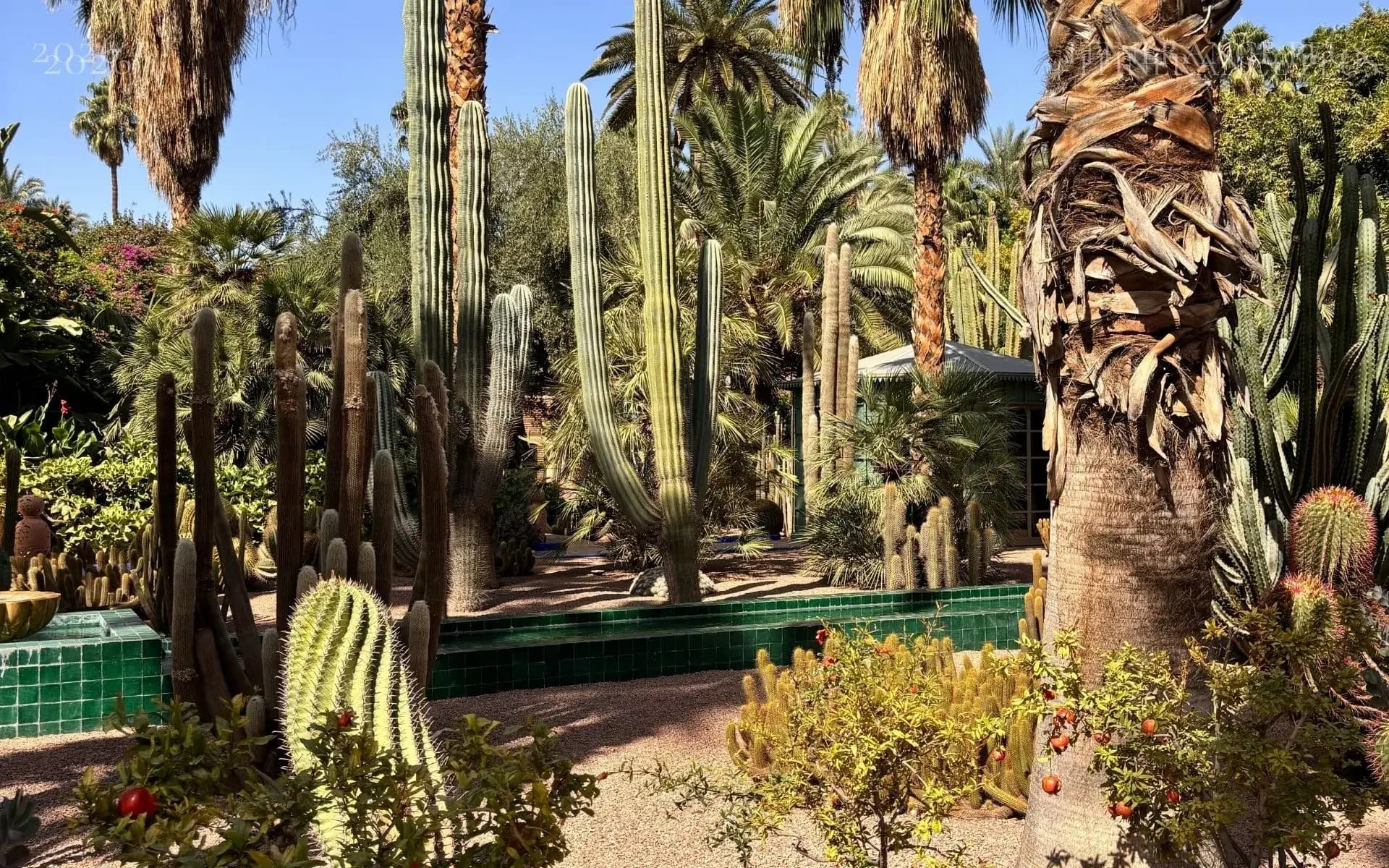
Majorelle Garden: an immersion in the cobalt blue of Marrakech
A sanctuary of freshness and color in the heart of Guéliz, where rare botany, Yves Saint Laurent's legacy and precise light meet.
Square
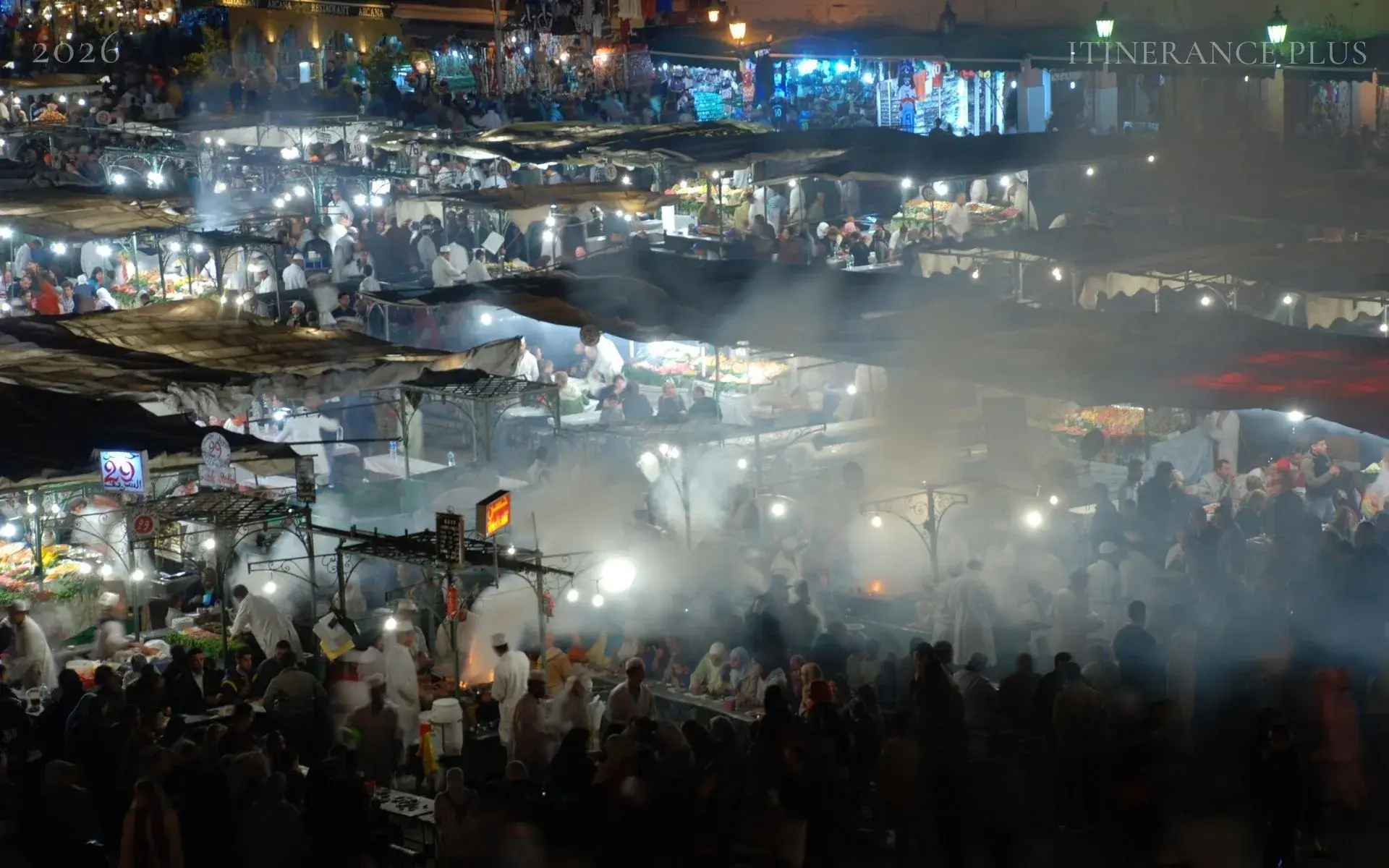
Jemaa el-Fna: diving into the vertigo of Marrakech
The smell of cedarwood smoke mixes with the scent of freshly pressed oranges, creating a dense, almost tangible atmosphere. In the distance, the first Maghreb call to prayer rises, filtered through the minarets of the...
Practical guides
Useful guides around this place
These guides help compare rhythms, formats and practical choices before shaping the visit.


Related experiences