Back to Marrakech
Square
Jemaa el-Fna: diving into the vertigo of Marrakech
Before visiting
Key takeThe smell of cedarwood smoke mixes with the scent of freshly pressed oranges, creating a dense, almost tangible atmosphere.
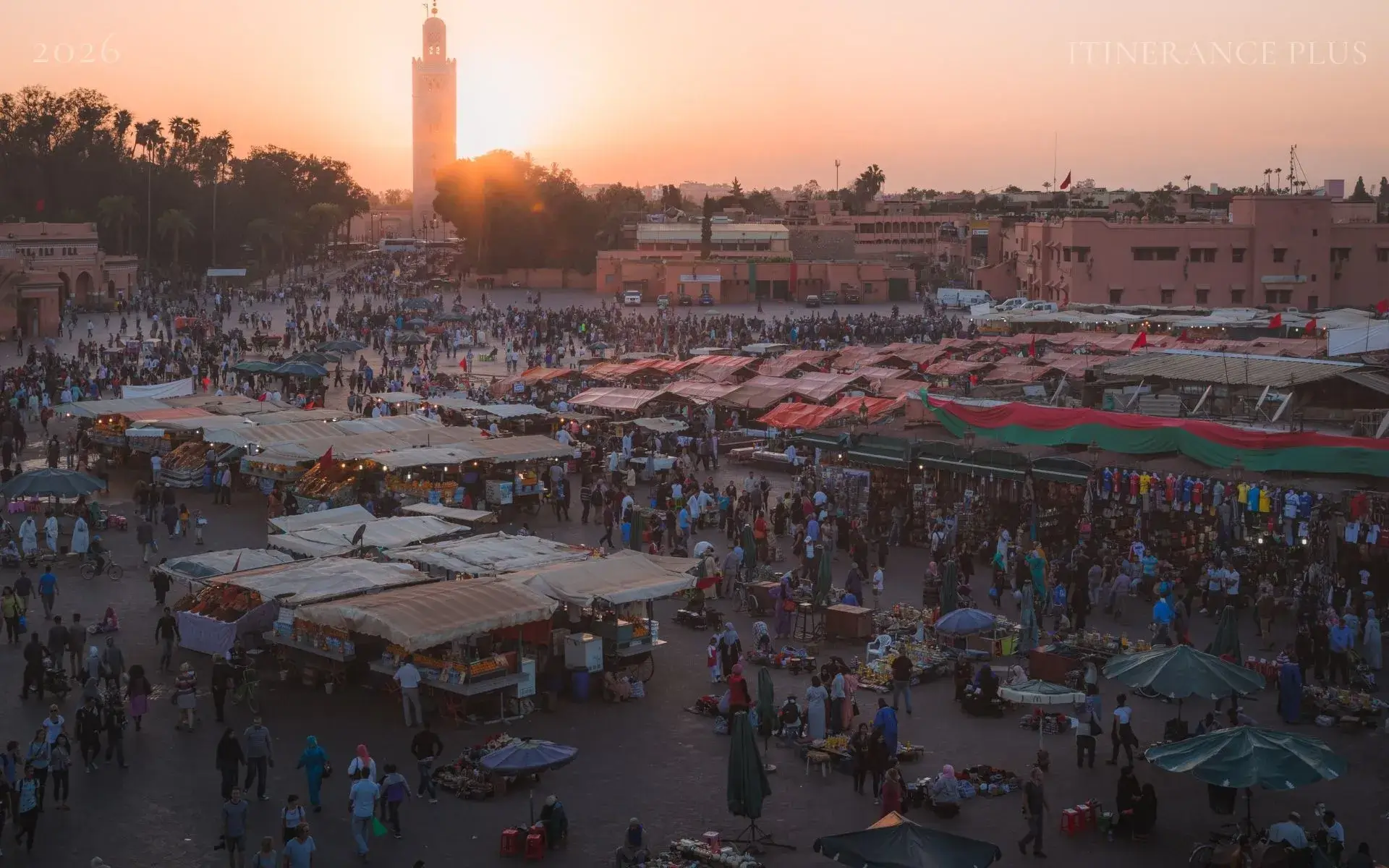
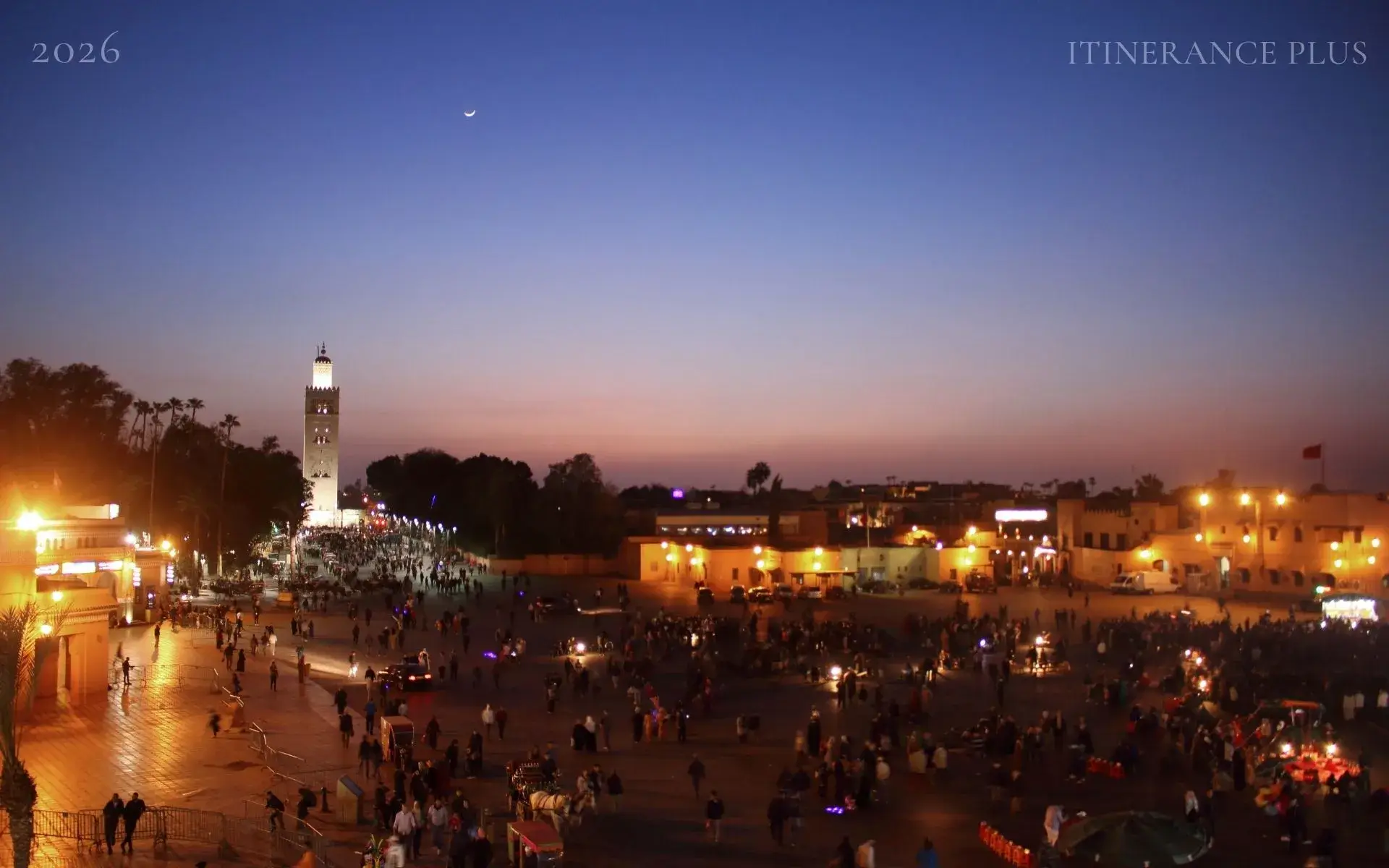
In the distance, the first Maghreb call to prayer rises, filtered through the minarets of the Koutoubia, while the Marrakech sky turns deep violet. Your feet touch the warm paving stones, still marked by the burn of the afternoon sun.
Around you, chaos organizes itself according to a thousand-year-old ritual. Water carriers in red costumes make their copper bells ring, a crystalline sound cutting through the murmur of passersby.
Suddenly, the rhythm of a gumbri and the beat of qraqebs pull you toward a circle of attentive men. You are at the center of Jemaa el-Fna, this open-air theater where every evening reality seems to tip into legend.
It is not a simple square, but a living organism breathing with the arrivals from the souk and the departures of the carriages. Here, the unexpected detail is not something you seek;
it attacks you: the piercing gaze of a storyteller, the whistle of a cobra flute, or the metallic taste of burning tea served in a chipped glass at a street stall.
Location
Insight
First impressions
The smell of cedarwood smoke mixes with the scent of freshly pressed oranges, creating a dense, almost tangible atmosphere.
In the distance, the first Maghreb call to prayer rises, filtered through the minarets of the Koutoubia, while the Marrakech sky turns deep violet. Your feet touch the warm paving stones, still marked by the burn of the afternoon sun.
Around you, chaos organizes itself according to a thousand-year-old ritual. Water carriers in red costumes make their copper bells ring, a crystalline sound cutting through the murmur of passersby.
Suddenly, the rhythm of a gumbri and the beat of qraqebs pull you toward a circle of attentive men. You are at the center of Jemaa el-Fna, this open-air theater where every evening reality seems to tip into legend.
It is not a simple square, but a living organism breathing with the arrivals from the souk and the departures of the carriages. Here, the unexpected detail is not something you seek;
it attacks you: the piercing gaze of a storyteller, the whistle of a cobra flute, or the metallic taste of burning tea served in a chipped glass at a street stall.
Insight
What secret lies behind the incredible dusk transformation of Jemaa el-Fna?
The passage from day to night on this esplanade is an organic experience that defies all urban logic. In the morning, the space seems empty, almost asleep, crossed only by a few bicycles and carts loaded with fresh mint.
But as soon as the shadow lengthens across the Medina walls, an army of men appears, carrying metal frames and wooden boards.
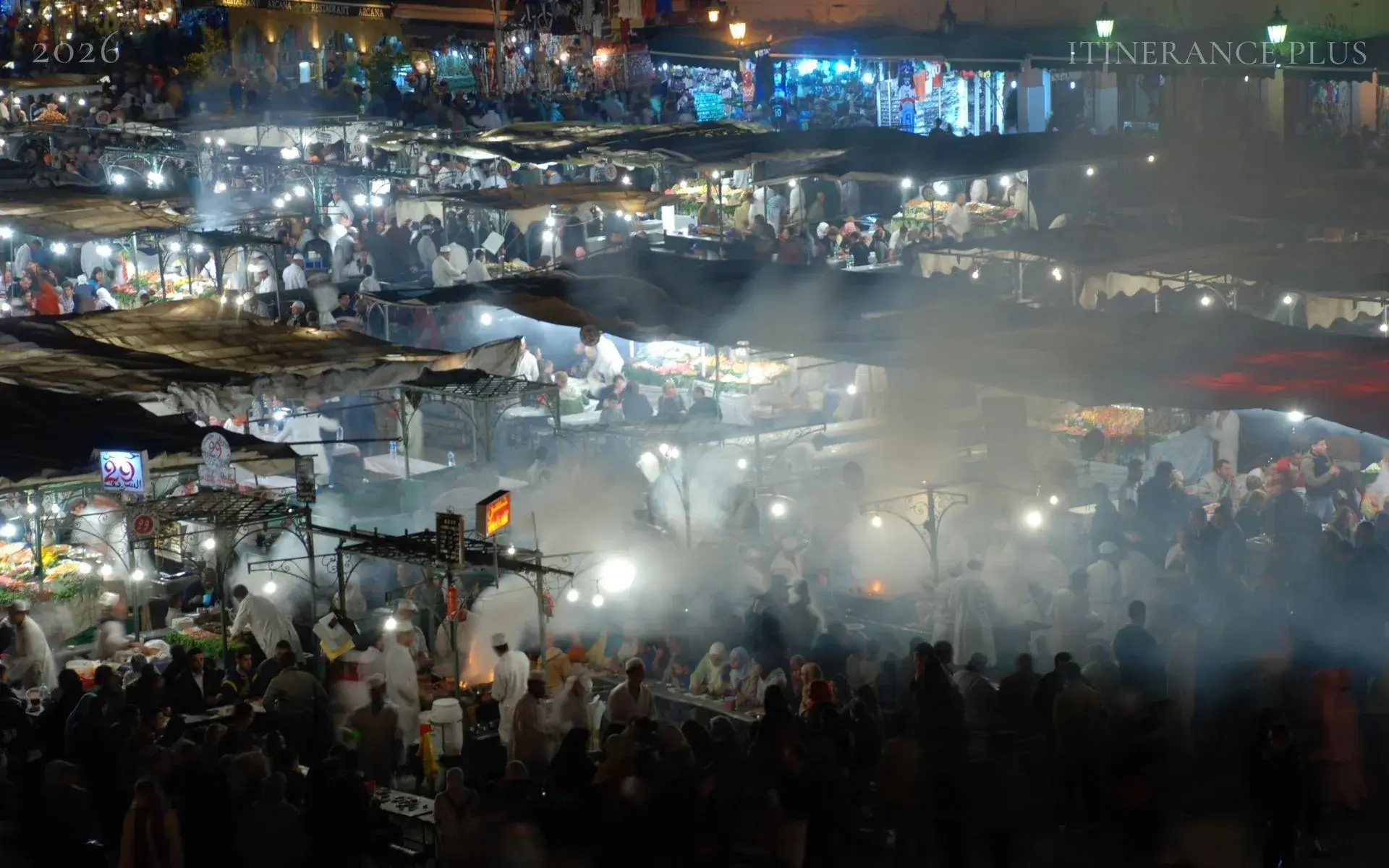
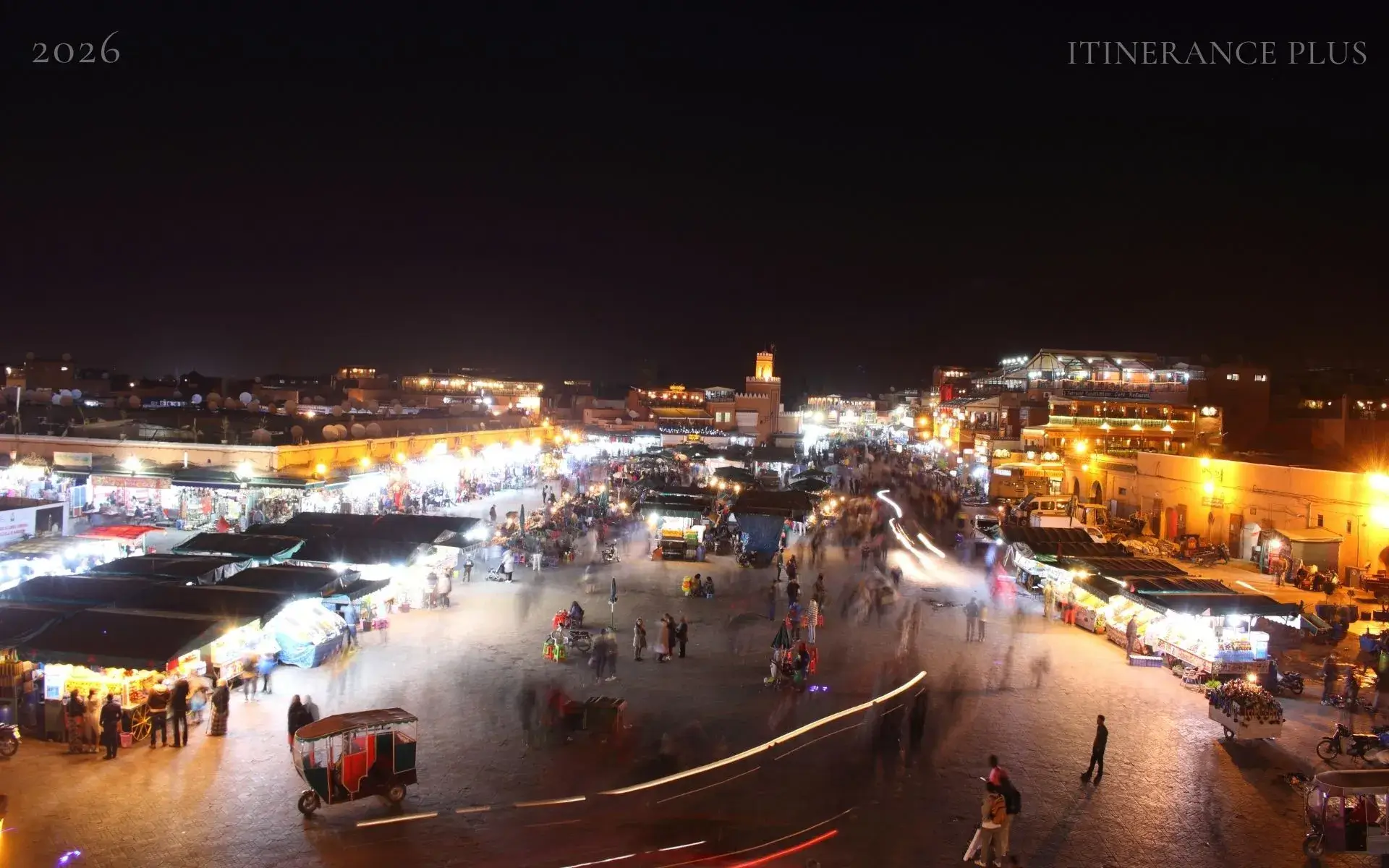
In less than an hour, dozens of temporary restaurants rise from the ground, their hand-painted numbers becoming landmarks for the hungry. Jemaa el-Fna changes face, shifting from a crossing point into a giant dining room.
The smoke from the grills begins to rise, forming a fragrant mist that wraps around the bare bulbs hanging above the tables.
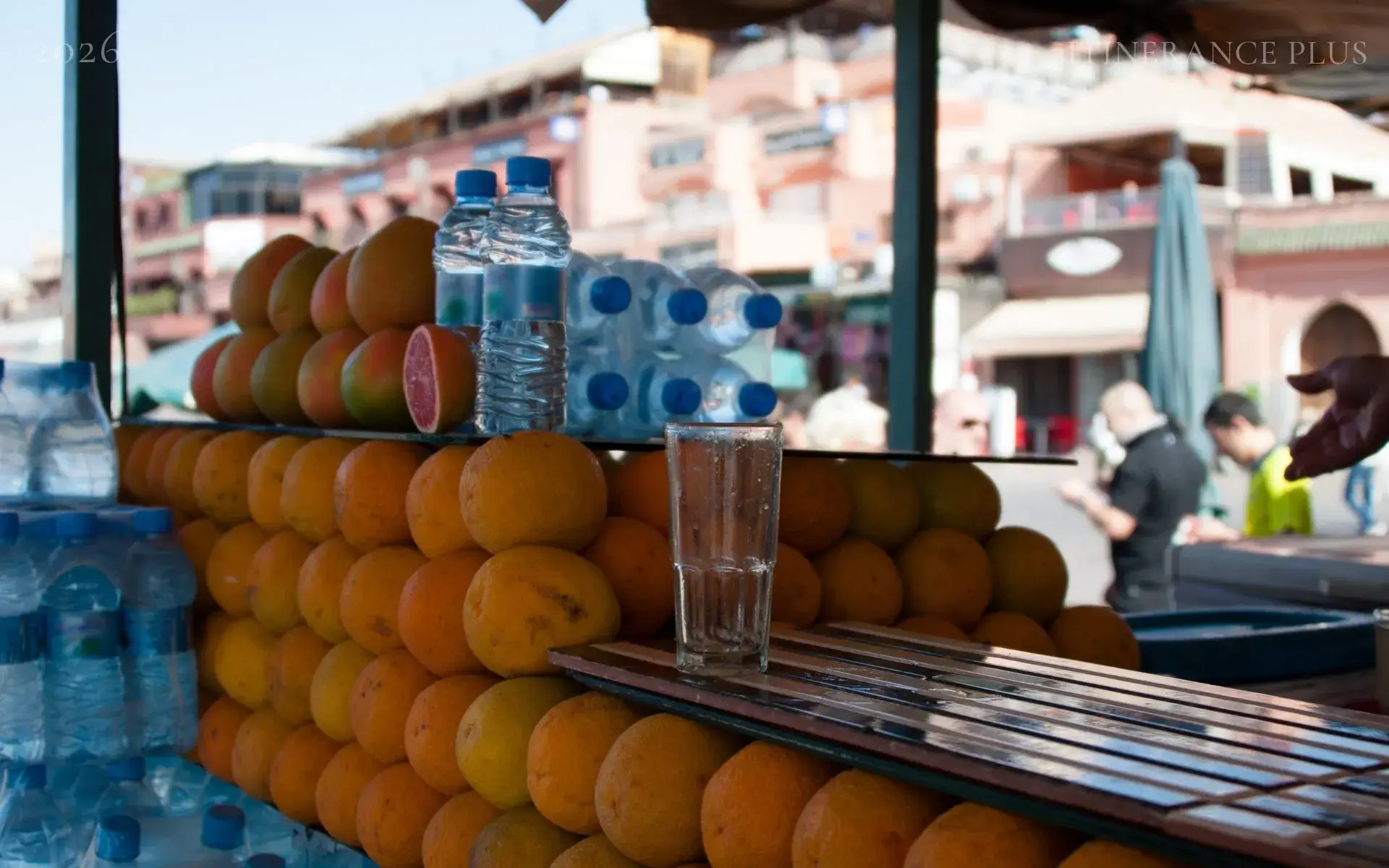
Orange juice sellers call out to passersby with sharp humor, while the first circles of spectators, the halqas, form around Gnaoua musicians. You feel that electricity in the air, that anticipation of a show with no script.
It is the moment when the borders between spectators and performers disappear. A tourist becomes the accomplice of a monkey handler, a local stops to hear the same epic once again from a toothless old man.
This transformation is a ballet regulated by centuries of practice. Each family occupies its precise place, each storyteller has an invisible territory.
The ground itself seems to vibrate under the weight of this frantic activity. From a high terrace, you see the human flow thicken, divide and whirl. It is a human tide that never stops, fed by dark alleys opening onto the harsh light of the square.
Night here is not made for sleep, but for celebrating the survival of tradition in a world that keeps accelerating.
Insight
How can you tame the culinary symphony of the night stalls?
Eating here is not a trivial act; it is a total sensory commitment. As soon as you approach the numbered stalls, the solicitations become physical. The smells of cumin, ginger and grilled meat pull you in every direction.
On wooden benches, you sit side by side with strangers, sharing the same round bread, khobz, still warm. Steam rises from large pots of harira soup, promising comforting smoothness made from tomatoes, chickpeas and coriander.
This is food of the moment, raw and generous, where flavors are not burdened by sophistication.
Skewers of liver wrapped in caul fat, spicy kefta and steamed sheep’s head are pillars of this nocturnal feast. For the more daring, snails in a broth of bitter herbs offer a singular taste experience, where salt and chili awaken the palate.
Every bite tells a story of terroir, of products brought each morning from the Menara gardens or the foothills of the Atlas. You do not come here for the refined gastronomy of riads, but for the truth of popular taste.
The soundscape becomes part of the meal. The clatter of plates, the shouts of servers announcing orders and bursts of laughter form a hypnotic background.
Drinking mint tea or a peppery ginger infusion at the end of the tasting is a necessary ritual. The burning liquid cleanses the palate and extends the contemplation of the surrounding spectacle.
It is in this blend of flavors and noises that Jemaa el-Fna reveals its most intimate essence: universal sharing around fire and food.
You will notice that despite the crowds, service is ruthlessly efficient. Behind the hosts’ smiles, you sense almost military organization.
Pyramids of olives and mountains of Moroccan salads made with tomatoes and roasted peppers are arranged to seduce the eye before convincing the stomach.
It is a fairground of the senses where every stall tries to outdo its neighbor through the freshness of its products or the liveliness of its replies.
History
Why are the storytellers the true guardians of this theater?
In the middle of the tumult, circles of silence sometimes form, broken only by the monotonous or exalted voice of a man at the center of a ring. These are the storytellers, the spiritual pillars of the square.
For centuries, they have orally transmitted tales from the Thousand and One Nights, Sufi fables and historical chronicles. To understand Marrakech, you must observe the faces turned toward the narrator.
Even if you do not speak Arabic or Berber, the intonation, broad gestures and dramatic silences are enough to transport you into another dimension.
The halqa, this circle of spectators, is a democratic space. You may find a wealthy merchant from Gueliz and a farmer from the south both hanging on the words of the master of ceremony.
The storyteller uses his body like an instrument, miming battles, lovers’ sighs or the tricks of djinns. It is a fragile art, threatened by screens and modernity, but one that still finds powerful resonance here.
These men are archivists of the Moroccan imagination, guardians of a memory that is not written down.
At the end of the story, the hat goes around. This is the moment of truth when the audience rewards the quality of the inner journey offered. Generosity matters, because keeping this profession alive is an act of cultural resistance.
As you move away from the circle, you realize that these stories soak into the walls of the Medina. They give meaning to the motifs on carpets in the dyers’ souk and to the interlacing carved plaster of madrasas.
The square then becomes a living library, a place where speech carries more weight than image.
This oral tradition is also a physical performance. Some storytellers add elements of magic, divination or improvised poetry. They adapt to their audience, sensing when to quicken the rhythm or ask a rhetorical question to revive attention.
It is a pure form of communication, without technological artifice, reminding us that human beings will always need stories to endure the hardness of reality.
Insight
What rhythms animate the rituals of musicians and dancers?
If storytellers address the mind, the musicians of the square take hold of your body. Gnaoua groups, with their cowrie-adorned caps and satin tunics, impose a haunting rhythm that borders on trance.
The heavy sound of the guembri, the traditional bass, vibrates in your chest. Dancers perform acrobatic jumps and frantic rotations, their tassels spinning with the percussion.
This is music from far away, from the caravan routes of sub-Saharan Africa, and it has found its sanctuary in Marrakech.
A few meters away, popular chaabi groups make violins tremble and strike derboukas. Here, lyrics celebrate daily life, love or religious devotion. Passersby stop for a few minutes, sketch a dance step or join in a familiar refrain.
Music is not a stage performance; it is an ongoing dialogue with the street. You feel that every note is a celebration of life, a way to ward off fate or give thanks for the day that has passed.
There are also the Aissawa dancers, whose high-pitched oboes, the rhaitas, tear through the air and provoke a kind of sonic intoxication. They are often seen during religious festivals, but on the square they maintain a constant presence.
Their music is an invocation, a raw force that seems capable of lifting dust from the ground. As you cross these different musical currents, you travel through the sound geography of the country, from desert to mountains.
The square acts like a natural amplifier. Noises collide without ever canceling each other out. You learn to isolate an instrument, to follow a particular melody in the middle of the roar.
It is an exercise in concentration that requires letting go, accepting that you cannot control everything. Music eventually becomes part of the setting, as inseparable from the place as the silhouettes of palms or the ochre color of the façades.
Craft
How do you navigate between craft and hustle in the surrounding souks?
Jemaa el-Fna is the entrance to a labyrinth of commerce that seems to have no end. As soon as you leave the open space and enter the lanes covered with reed screens, the atmosphere changes. Light becomes muted, sounds are muffled.
This is where the economic heart of the old city beats. In the metalworkers’ quarter, hammers strike metal with industrial rhythm while sparks fly in the half-light.
Chiseled lanterns, ready to be shipped, shine like miniature constellations.
The spice souk is a visual shock. Perfect cones of saffron, paprika and turmeric are aligned with obsessive precision. The air is saturated with peppery scents that make novices sneeze.
Merchants call you over to taste a menthol crystal or praise the virtues of hand-pressed argan oil. It is a permanent negotiation game, a social dance where price is only a pretext for conversation.
You learn patience, the art of compliment and polite firmness.
Deeper in, you reach the leatherworkers’ souk. The smell of tanned leather is strong, almost animal. Thousands of colored babouches hang from ceilings, forming chromatic waves.
You see artisans at work, bent over their benches, cutting and sewing with disconcerting speed. Here you understand that Marrakech is a city of builders and makers. Nothing is thrown away; everything is transformed, repaired and reinvented.
The return toward the main square often passes through the herbalists’ quarter, where jars filled with strange roots and dried chameleons stand beside modern remedies. It is a mix of ancestral knowledge and tourist marketing.
You need to keep a critical eye while allowing yourself to be charmed by the sellers’ patter. Every object bought here carries a fragment of that agitation, a tactile memory of the shadows and lights of the labyrinth.
Insight
Why climb to the terraces to gain perspective?
To grasp the scale of the spectacle, you sometimes need to physically step out of it. The many cafés lining the esplanade offer panoramic terraces that are balconies over humanity.
From above, the noise rises like a dull hum, less aggressive. You see population flows crossing, carriages weaving between pedestrians and the lights of the stalls turning on one by one.
It is the ideal moment to order a nous-nous, the typical coffee with milk, and open a notebook.
From these observatories, the geography of the city becomes clear. You can identify minarets, hidden riad gardens and, in the distance, the white line of the Atlas peaks watching over the city.
The shifting light of sunset changes the color of the walls from bright orange to powder pink. It is a lesson in natural aesthetics.
You also see domestic life on neighboring roofs: laundry drying, children playing, women talking away from the gaze of the street.
The contrast between the frenzy below and the relative serenity above is striking. You become aware of the circular aspect of the square, of this organic form that resisted urban planners.
It is also a chance to take photos without being solicited every two minutes. The silhouettes of water carriers or the circles of storytellers become graphic motifs, artistic compositions capturing the spirit of the place.
Going back down after an hour of contemplation is a shock. You return to the crowd with a new gaze, more attentive to details you had not noticed before.
The terrace is not an escape, but a necessary punctuation in the day’s story. It allows you to digest the intensity of what happens on the ground and prepare for the rest of the night, because on this earth the spectacle never really stops;
it only changes performers.
Insight
Final impressions
As you leave the square and your steps lead you back toward the calm of your riad, you can still feel drum vibrations in your ankles. The dust of the city has left a taste of earth and cinnamon on your lips.
You think back to that old man who smiled at you without asking for anything, simply happy to share for an instant the same emotion before a magic trick. This is not a city one visits;
it is an experience one undergoes with delight, a permanent assault on the certainties of organized travelers.
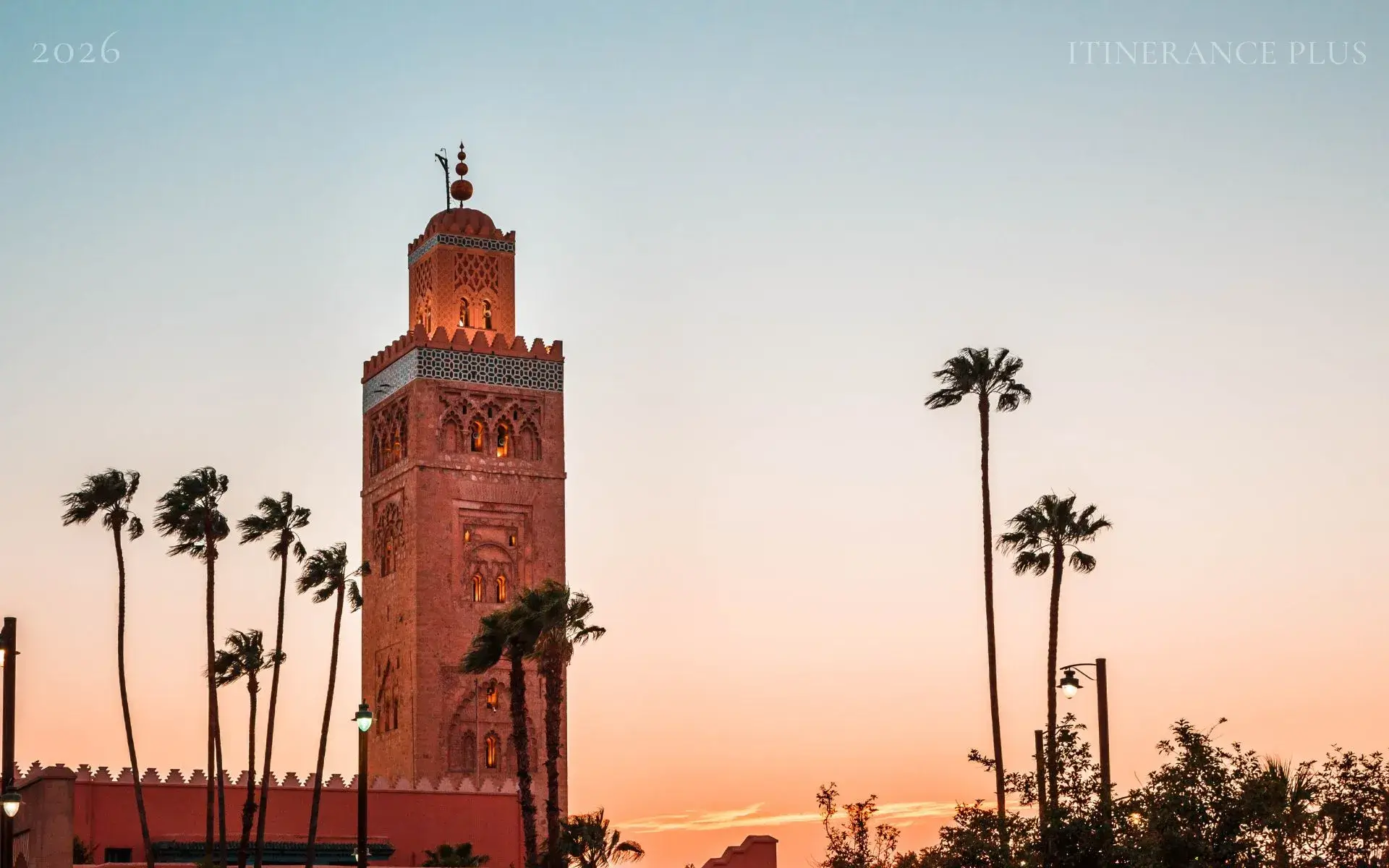
Closing your eyes, the image of the Koutoubia cut against the night sky remains engraved, a reassuring lighthouse in the ocean of life that is Jemaa el-Fna.
You already know that tomorrow you will return, drawn by that visceral need to lose yourself once again in the vertigo of Marrakech.
Practical box: organizing your immersion
Best time to visit: Spring, from March to May, and autumn, from September to November, are the most pleasant periods to avoid the crushing summer heat that can make the crowd stifling.
Average daily budget: Between 150 and 300 dirhams per person is more than enough to enjoy the street stalls, drink several teas and leave a few tips for performers.
How to get there: Most riads in the Medina are within walking distance. Otherwise, ask a taxi to drop you at Arset El Bilk, just beside the Koutoubia Mosque.
Ideal visit duration: You need at least three visits at different times of day to understand the square’s cycle, but spending two full evenings there is the minimum to absorb the atmosphere.
Frequently asked questions
Everything about Jemaa el-Fna: diving into the vertigo of Marrakech
Other places to discover
More places to explore nearby
Garden
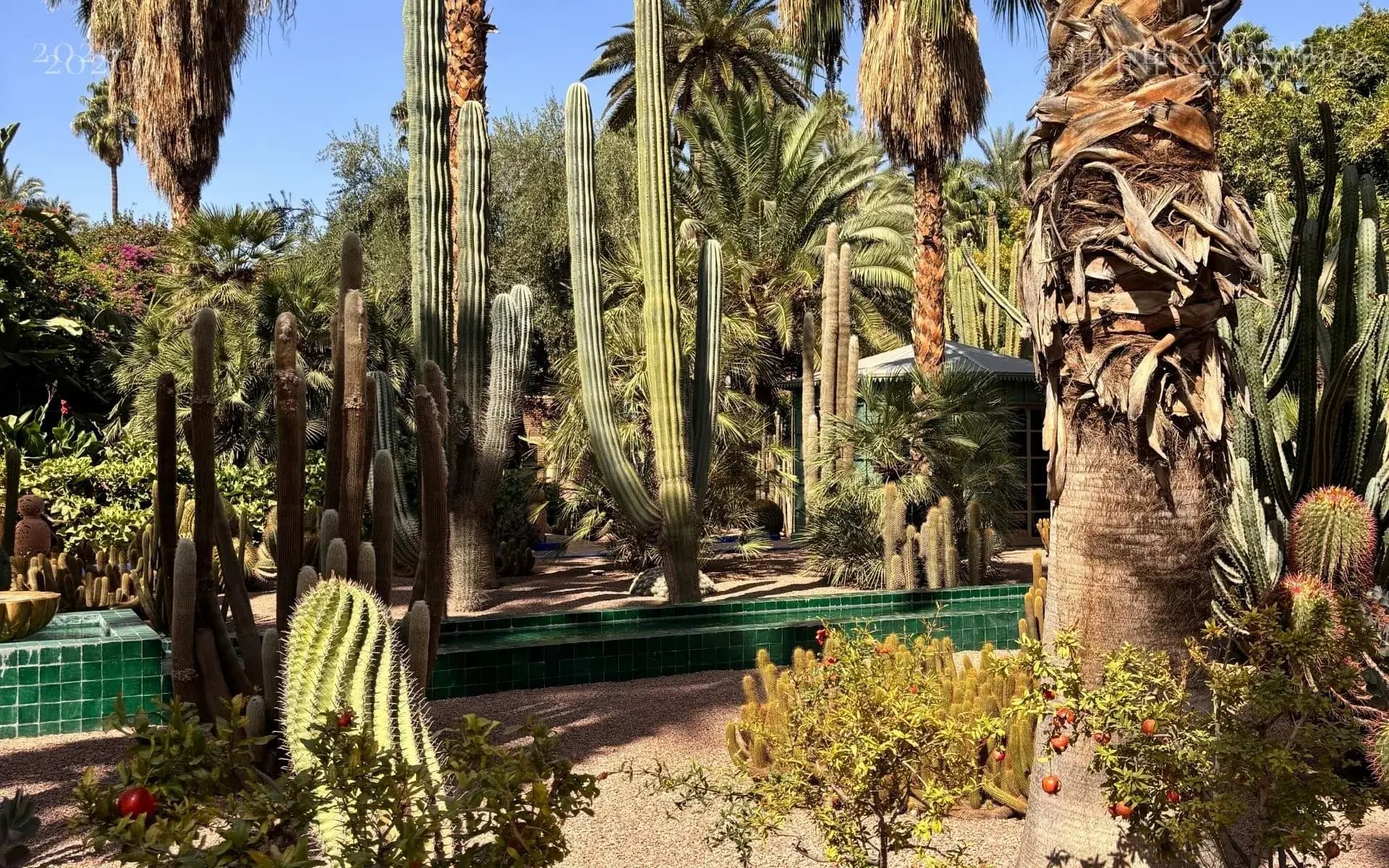
Majorelle Garden: an immersion in the cobalt blue of Marrakech
A sanctuary of freshness and color in the heart of Guéliz, where rare botany, Yves Saint Laurent's legacy and precise light meet.
Monument
Koutoubia: contemplating the rose-stone soul of Marrakech
The tower rising in front of you is not only a technical achievement, but the living narrative of a dynasty determined to leave its mark on the world. The Almohads, rigorous builders, raised this minaret with a geomet...
Practical guides
Useful guides around this place
These guides help compare rhythms, formats and practical choices before shaping the visit.

Related experiences