Back to Marrakech
District
Hivernage District: The Art of Living Between Gardens and Palaces
Before visiting
Key takeThe screech of a sedan's tires on smooth asphalt fades behind the rustle of the giant palm trees lining the avenues.
Here, the air seems lighter, scented by the aromas of jasmine and orange blossom escaping from invisible gardens hidden behind high bougainvillea hedges.
You walk on wide sidewalks bordered by perfectly pruned roses, while the setting sun sets the ochre facades of prestige hotels ablaze. The Hivernage District does not offer itself to those who hurry; it is savored like a mint tea served on a marble terrace.
In the Hivernage District , the fury of the Medina is no more than a distant memory, a rumor muffled by the sovereign elegance of this residential and hotel sector born under the protectorate.
Delving into its shaded alleys, you discover a facet of Marrakech where luxury is discreet, almost contemplative by day, before igniting with electric energy once night falls.
It is here that people come to find a bubble of absolute calm, a luxury of space and time that seems to suspend the world's mad race.
Location
Insight
First impressions
The screech of a sedan's tires on smooth asphalt fades behind the rustle of the giant palm trees lining the avenues.
Here, the air seems lighter, scented by the aromas of jasmine and orange blossom escaping from invisible gardens hidden behind high bougainvillea hedges.
You walk on wide sidewalks bordered by perfectly pruned roses, while the setting sun sets the ochre facades of prestige hotels ablaze. The Hivernage District does not offer itself to those who hurry; it is savored like a mint tea served on a marble terrace.
In the Hivernage District , the fury of the Medina is no more than a distant memory, a rumor muffled by the sovereign elegance of this residential and hotel sector born under the protectorate.
Delving into its shaded alleys, you discover a facet of Marrakech where luxury is discreet, almost contemplative by day, before igniting with electric energy once night falls.
It is here that people come to find a bubble of absolute calm, a luxury of space and time that seems to suspend the world's mad race.
Gardens
Why are the Menara Gardens the Lungs of this Sector?
At the edge of the residential area, the Menara gardens offer a perspective that seems to stretch to the infinity of the Atlas peaks. Crossing the entrance, you are welcomed by a forest of ancient olive trees whose gnarled trunks tell centuries of patience.
The beaten earth floor crunches under your soles, and the smell of dry grass mingles with the coolness of the water irrigating the plots.
In the center, the immense basin reflects the pavilion with its green tile roof, creating an image of perfect symmetry that has inspired generations of poets and travelers.
Here, you meet locals who have come to find a bit of coolness under the foliage, far from the urban heat. Families settle for long improvised picnics, while lovers stroll through the straight alleys. The sensation of peace is immediate.
You can stay for hours by the basin, observing the ballet of fish and the changing reflection of clouds on the flat surface.
It is a necessary breathing space, a place where the geometry of nature reasserts its rights over human agitation, offering a striking contrast with the density of neighboring districts.
The evening light transforms the place into a dream setting. When the sun begins its descent, the snowy peaks in the distance take on shades of pink and purple, while the pavilion stands out as a silhouette against a fire sky.
It is a moment of pure grace, an invitation to slowness.
Leaving this park to return to the heart of the hotel zone, you carry this mineral serenity with you, understanding that the DNA of this place rests on this rare alliance between water, earth, and sky—a triptych that defines the very essence of the oasis.
Architecture
How Does the Architecture of the Palaces Define the Horizon?
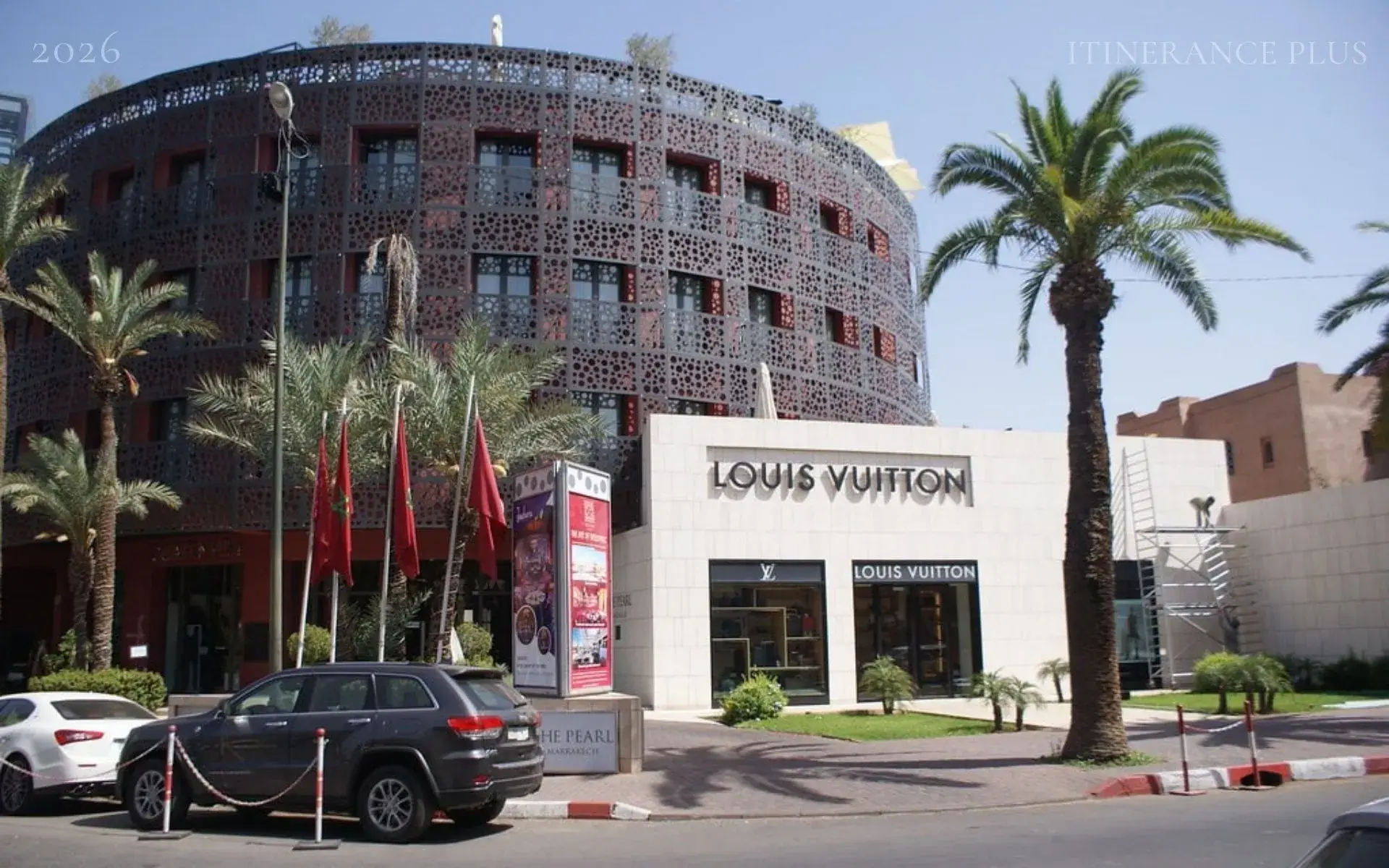
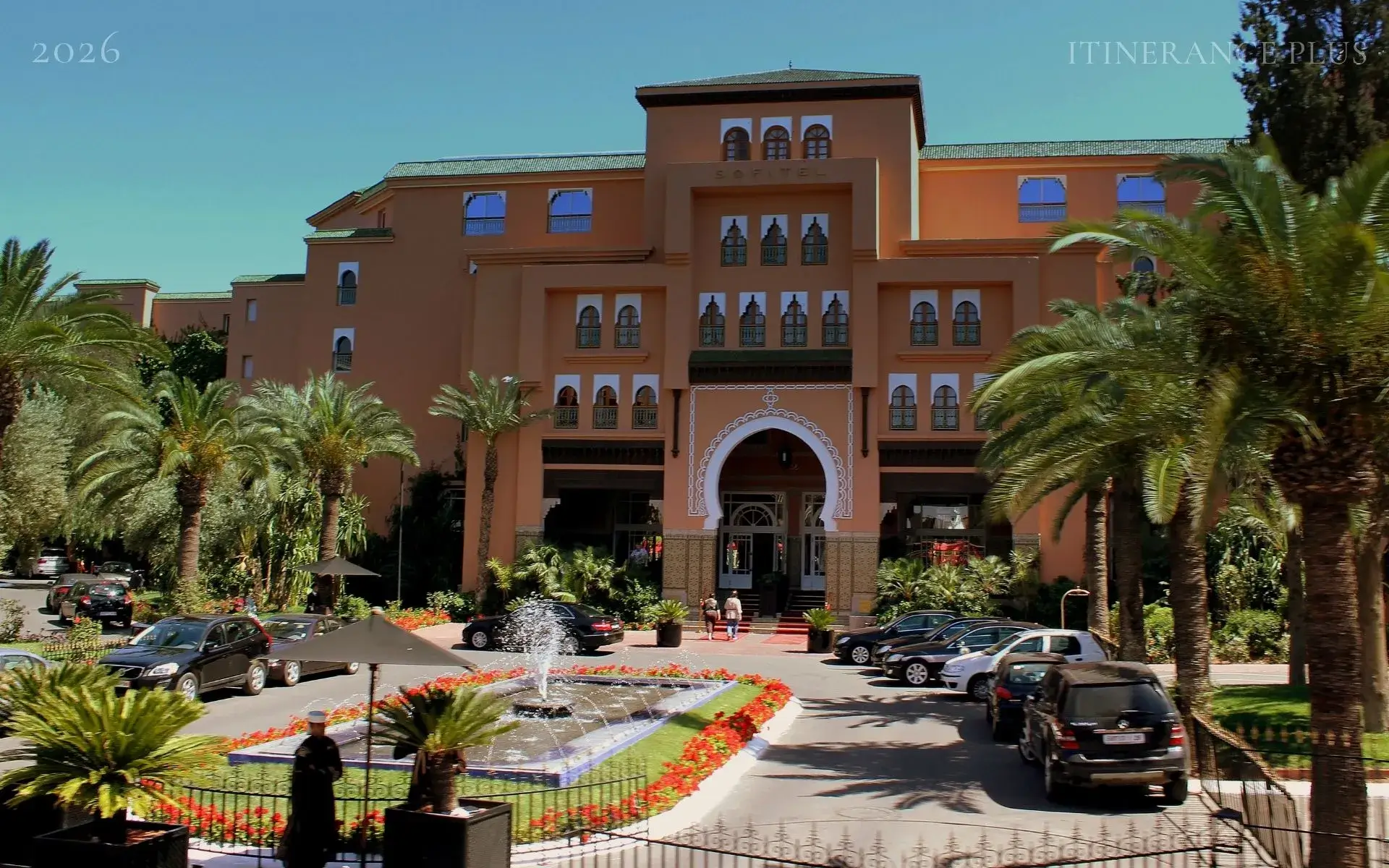
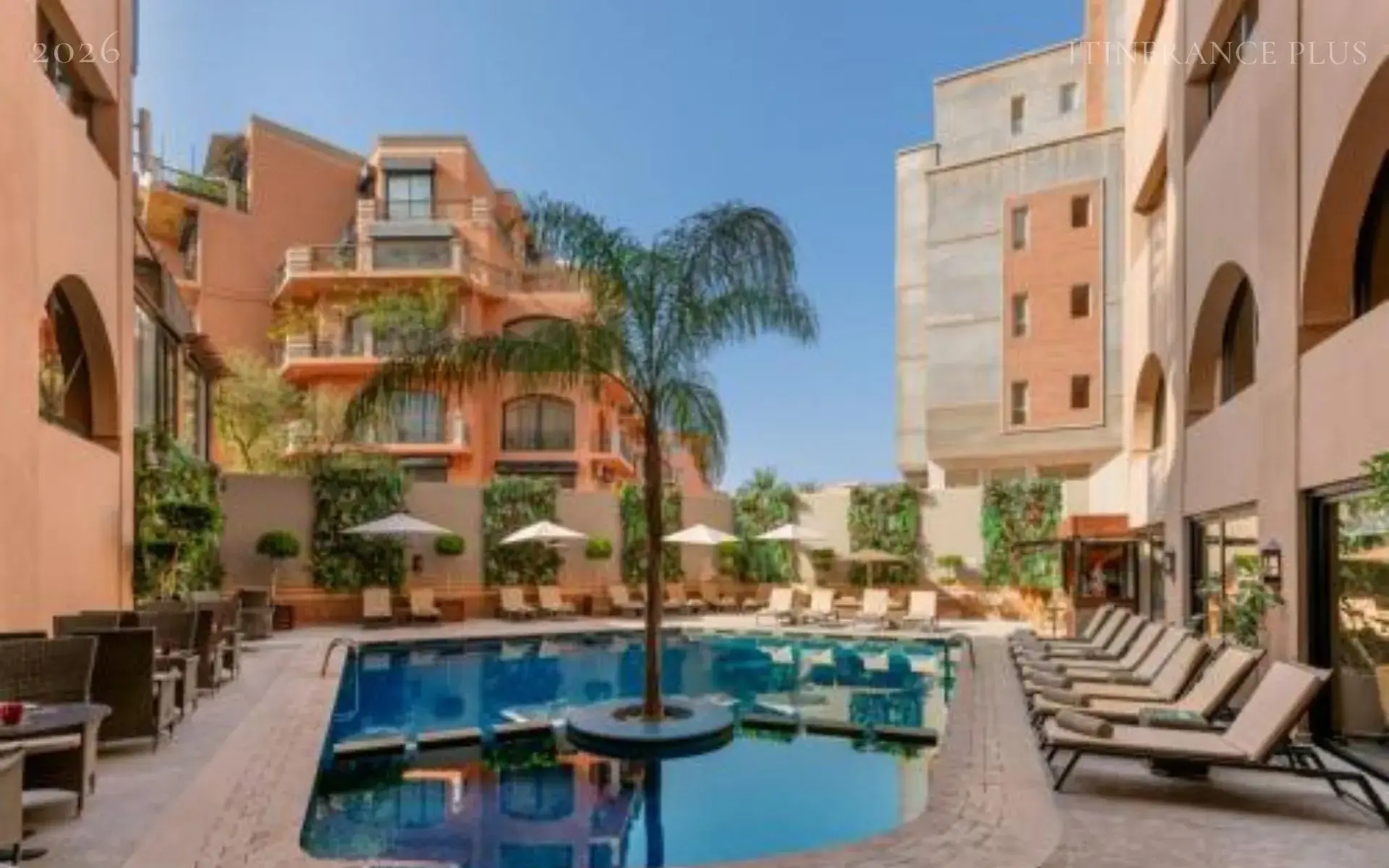
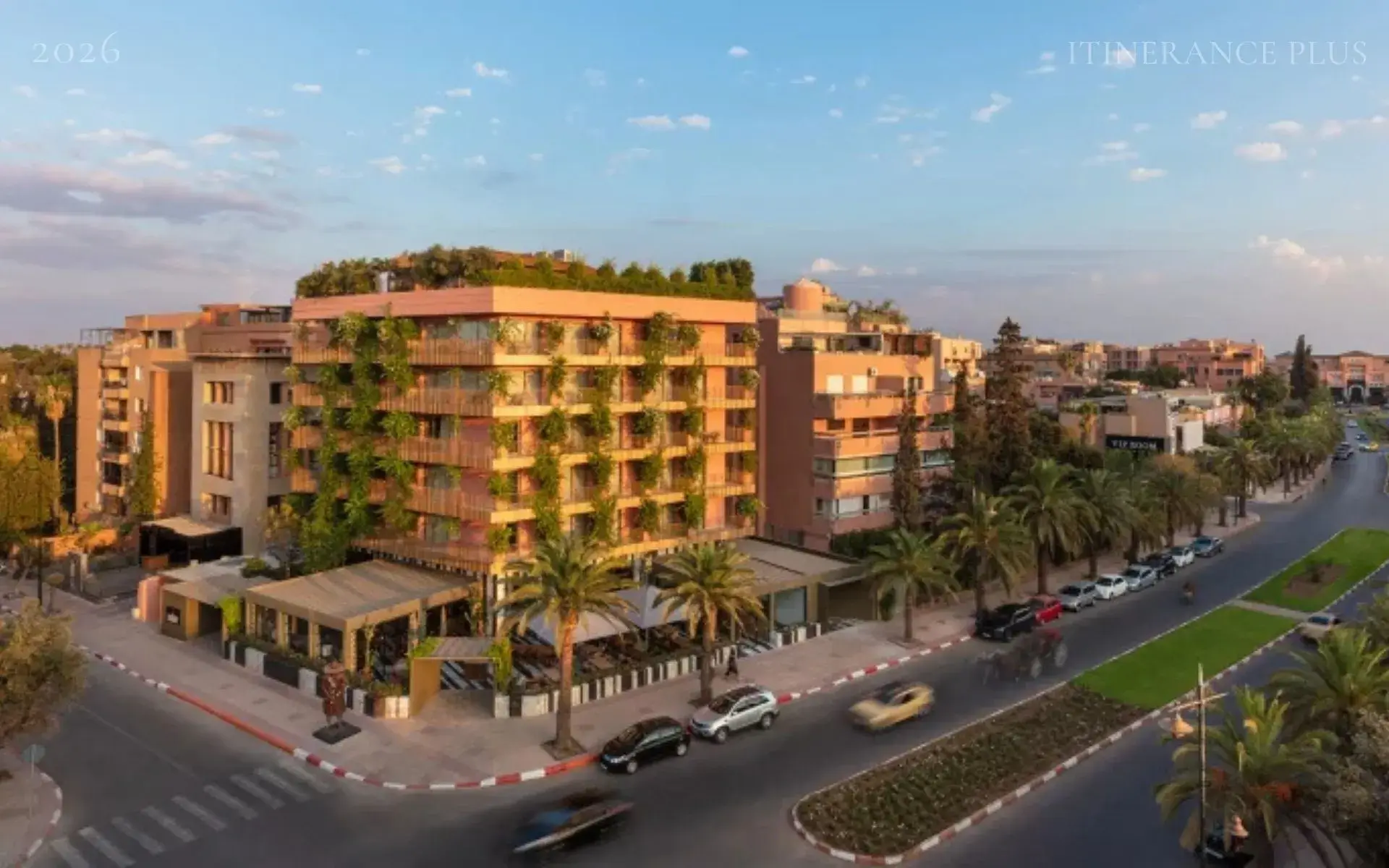
The urban landscape here is a celebration of controlled excess. Legendary establishments like the Mamounia or the Royal Mansour impose their majestic silhouettes, surrounded by gardens that are true botanical masterpieces.
Walking along their walls, you see monumental doors made of carved cedar wood and ironwork of incredible finesse. These buildings are not just places to stay;
they are monuments to the glory of Moroccan craftsmanship, where every zellige, every piece of chiseled plaster bears witness to a skill passed down from generation to generation.
The architecture plays with volumes and perspectives. The facades adopt the codes of the Moorish style, with horseshoe arches and interior patios where the murmur of fountains replaces the noise of the city.
You discover a sublimated version of the traditional home, where luxury does not lie in ostentation but in the quality of materials: Italian marble sits alongside Ourika stone, Fez silks dress the lounges, and leather is worked with the suppleness of a glover.
It is an aesthetic of contemplation, where the eye rests on details of surgical precision.
Strolling through the halls of these palaces, even without residing there, you feel the weight of history. The most illustrious personalities of the 20th century have walked these carpets, leaving behind an aura of mystery and glamour.
The staff, in impeccable livery, move with the discretion of ghosts, ensuring a fluidity of service that seems to border on magic.
This architecture of service and welcome creates a timeless atmosphere, a protective bubble where the traveler feels like the guest of honor in a modern court, far from the standardized norms of major global chains.
Insight
What is this Energy that Grips the Streets at Nightfall?
As soon as the sun disappears behind the ramparts, the district changes face to become the epicenter of nightlife. The most famous nightclubs, hushed cocktail bars, and dinner-shows light up, attracting an international clientele and the local golden youth.
The atmosphere becomes electric. You see luxury cars passing in front of the entrances of mythical places like the Theatro or the Casino de Marrakech , while the bass of contemporary music begins to vibrate through the walls.
The contrast is striking with the calm of the afternoon. The night scene is a riot of creativity, where international DJs succeed each other behind the decks and where performances by dancers and acrobats animate dinners.
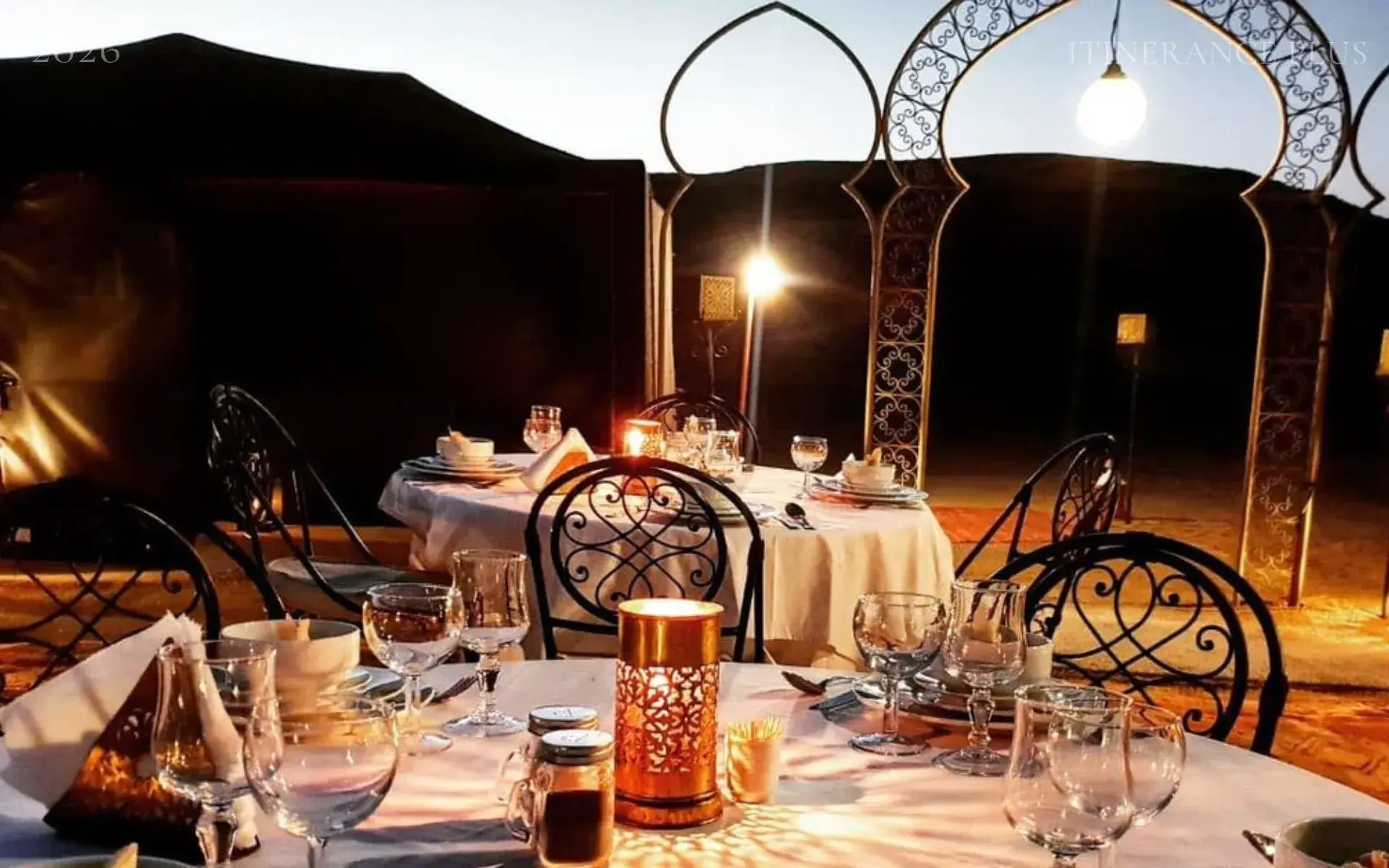
You can savor inventive fusion cuisine, blending local spices and Japanese techniques, in settings that rival each other in audacity, between hanging gardens and Baroque lounges.
It is here that Marrakech asserts its modernity, its capacity to celebrate with an intensity that has nothing to envy of European capitals.
Yet, this agitation retains a form of refinement. The terraces remain privileged meeting places where people talk until dawn while savoring fine pastries or fresh fruit nectars.
The scent of apple hookah floats in the warm air, mixing with the expensive perfumes of night owls. This energy does not seek to be aggressive; it is a celebration of life, a way to prolong the magic of the day into the darkness.
Getting lost in this permanent party, you realize that the sector has succeeded in the mad bet of being both a monastery of peace by day and a temple of celebration by night.
Viewpoint
Why are the Panoramic Terraces the Best Observatories?
Taking height is undoubtedly the best way to understand the geography of this district. The rooftops of modern hotels offer 360-degree views over the entire ochre city.
From up there, you see the Koutoubia stand out proudly on the horizon, while the roofs of the Medina stretch out like a carpet of red bricks at your feet.
To the south, the Atlas Mountains seem within reach, especially on clear days when every fold of the terrain can be distinguished.
Settling on one of these terraces at the time of the blue hour is an unforgettable sensory experience. You order a signature cocktail, often infused with cinnamon or hibiscus, and you watch the city lights turn on one by one.
The wind blows lightly, bringing a welcome coolness after the heat accumulated on the ground.
It is here that you grasp the scale of the vegetation: from above, the district looks like an urban forest dotted with turquoise pools that shine like emeralds under the darkening sky.
These places are also spaces of social mixing where travelers from around the world cross paths with local entrepreneurs. Conversations start easily, facilitated by the beauty of the panorama.
People exchange advice on the best spots in the city or on excursions to be made in the surrounding valleys. Standing still facing this spectacle, you perceive the breath of Marrakech, this unique blend of millennial tradition and contemporary dynamism.
The panoramic terrace is not just a place for consumption; it is a privileged observation post for the Moroccan soul, a place where one feels both above it all and deeply connected to the earth.
Insight
Can Local Flavors Still Be Found Amidst the Luxury?
While the sector is known for its international tables and gastronomic cuisine, it also hides gems where local flavors are treated with royal demand.
In the shaded gardens, you can savor tagines slow-cooked in earthenware pots, whose melting meat falls off the fork.
You are served Moroccan salads of incredible finesse, where orange, cinnamon, and carrot create sweet-and-sour harmonies that wake up your taste buds. Here, the product is king, often from organic vegetable gardens located at the foot of the mountains.
The ritual of mint tea takes on a ceremonial dimension here. It is brought to you in chiseled silver teapots, the amber liquid poured from a great height to create a light foam.
Accompanied by gazelle horns or honey briouates, it is a necessary break that punctuates your day of visiting. You also discover modern variations on classic dishes, such as a revisited seafood pastilla or a seven-vegetable couscous presented as a work of art.
Gastronomy is a language here, a way of expressing the generosity of a people through the sophistication of a palace.
For those seeking more simplicity, the luxury bakeries in the district offer warm anise or cumin breads, whose smell guides you from the morning.
It is this mix of genres that makes the culinary charm of the zone: one can dine under the crystal chandeliers or snack on roasted almonds by a swimming pool.
The demand for quality remains the same, because here, taste is a serious matter. Savoring these dishes, you understand that Moroccan tradition is not incompatible with the most cutting-edge modernity; on the contrary, it is its nurturing foundation.
Gardens
How do Culture and Art Invite Themselves into the Gardens?
Beyond hotels and celebrations, the district is also a ground of expression for contemporary art. Several palaces and prestige establishments host exhibitions of monumental sculpture in their gardens.
Walking around, you might come across a Corten steel work or a blown glass installation placed on an impeccable lawn, creating an unexpected dialogue between current creation and the classic setting of the parks.
It is an open-air museum, where art is experienced at the rhythm of the stroll.
Some places also house small private galleries or concept stores where one can acquire design objects inspired by local craftsmanship.
You discover Berber carpets with abstract patterns, lighting fixtures that revisit the technique of hammered copper, or silver jewelry of radical modernity. Art does not settle for being decorative;
it questions, it shakes up codes, and it invites an inner journey. It is this cultural dimension that gives the sector its depth and nobility, far from a simple resort area.
The Royal Opera, located nearby, is another major monument that highlights the cultural vocation of this city extension. Its imposing architecture and eclectic programming attract lovers of classical music, theater, and dance.
Participating in an event in these places is to immerse oneself in an atmosphere of prestige and sharing.
You realize that this district is the meeting point between East and West, a crossroads where the most diverse artistic expressions meet and enrich each other, making every stay a permanent intellectual discovery.
Insight
Why are Spas and Hammams Sanctuaries of Rebirth?
One cannot leave this place without having tested the royal hammam experience. Here, the ancestral ritual of purification is elevated to the rank of sacred art.
You enter heated marble rooms, where steam envelops your body like a coat of softness. The scent of eucalyptus black soap and the precise gesture of the scrub transport you into a state of deep relaxation.
It is a moment of reconnection with oneself, far from the noise and fury of the outside world.
The spas of major establishments use natural products from the Moroccan soil: argan oil, rose water from the M'Goun valley, Ghassoul clay. These ingredients, used for millennia, bring a unique sensory dimension to your treatments.
You are massaged with hot stones, wrapped in honey, and it ends with an infusion of calming plants in a rest lounge where time seems to have stopped. It is a physical and mental rebirth that prepares you to face the city's overflowing energy again.
The aesthetic dimension of these treatment spaces is also paramount. The swimming pools, the play of dim light, and the religious silence that reigns there create a sanctuary of absolute peace.
You come out with soft skin and a clear mind, understanding that the real luxury here is not only in the gilding, but in this capacity to offer you a moment of total silence in the heart of a city that never sleeps.
The hammam is the cornerstone of the local art of living, a mandatory stop for anyone who wants to understand the secret of the vitality of Marrakech's inhabitants.
Insight
Practical Inset: Preparing Your Escape
Best time to visit : Autumn and spring remain the royal seasons. Temperatures oscillate between twenty and twenty-five degrees, and the light is of absolute clarity. In winter, days are mild and evenings cool, ideal for enjoying the fireplaces of the palaces.
Average daily budget : This is the most expensive sector. Count at least fifteen hundred to two thousand Dirhams per person per day for an experience including a fine table, spa access, and a night out, not including accommodation.
How to get there : The district is perfectly served by small taxis and is located less than ten minutes by car from Marrakech-Menara International Airport. You can also reach Jemaa el-Fna Square in fifteen minutes on foot.
Ideal duration of stay : Three to four days allow you to fully enjoy the hotel infrastructure, relax at the spa, and discover the nightlife scene without rushing, while keeping time for the gardens.
Frequently asked questions
Everything about Hivernage District: The Art of Living Between Gardens and Palaces
Other places to discover
More places to explore nearby
Garden
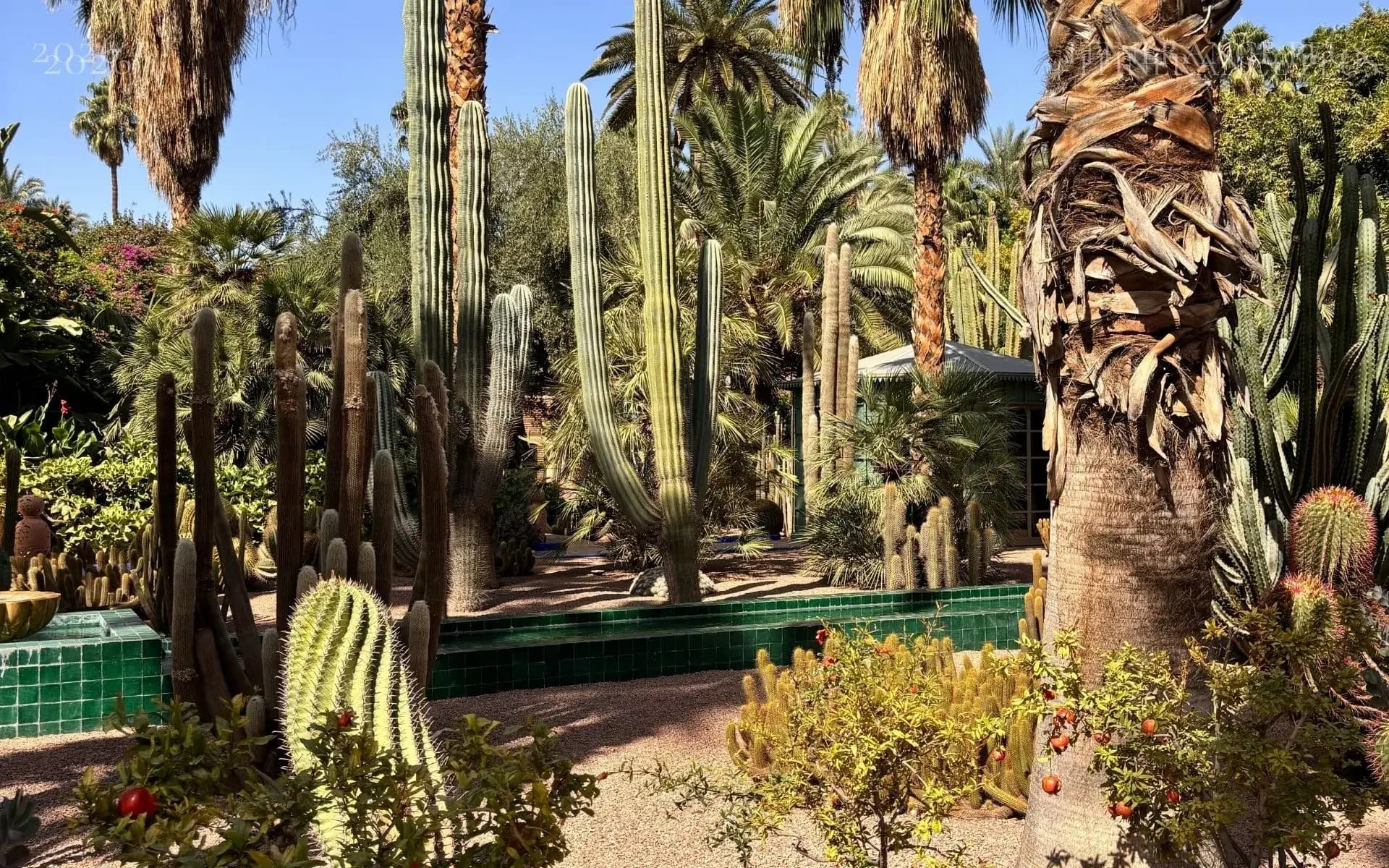
Majorelle Garden: an immersion in the cobalt blue of Marrakech
A sanctuary of freshness and color in the heart of Guéliz, where rare botany, Yves Saint Laurent's legacy and precise light meet.
Square
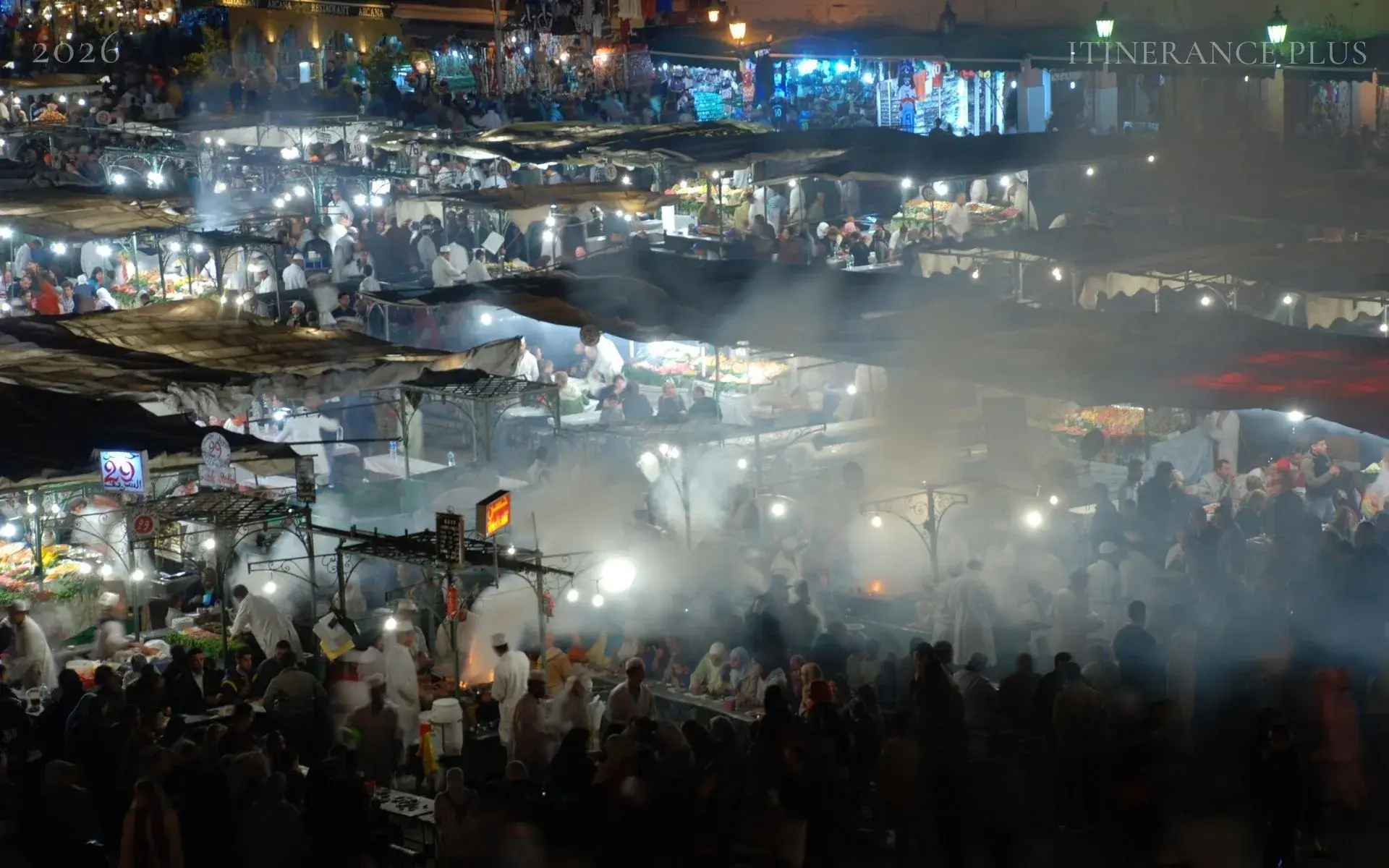
Jemaa el-Fna: diving into the vertigo of Marrakech
The smell of cedarwood smoke mixes with the scent of freshly pressed oranges, creating a dense, almost tangible atmosphere. In the distance, the first Maghreb call to prayer rises, filtered through the minarets of the...
Practical guides
Useful guides around this place
These guides help compare rhythms, formats and practical choices before shaping the visit.


Related experiences