Back to Marrakech
Museum
Le Musée Yves Saint Laurent Marrakech : l'élégance de la brique
Before visiting
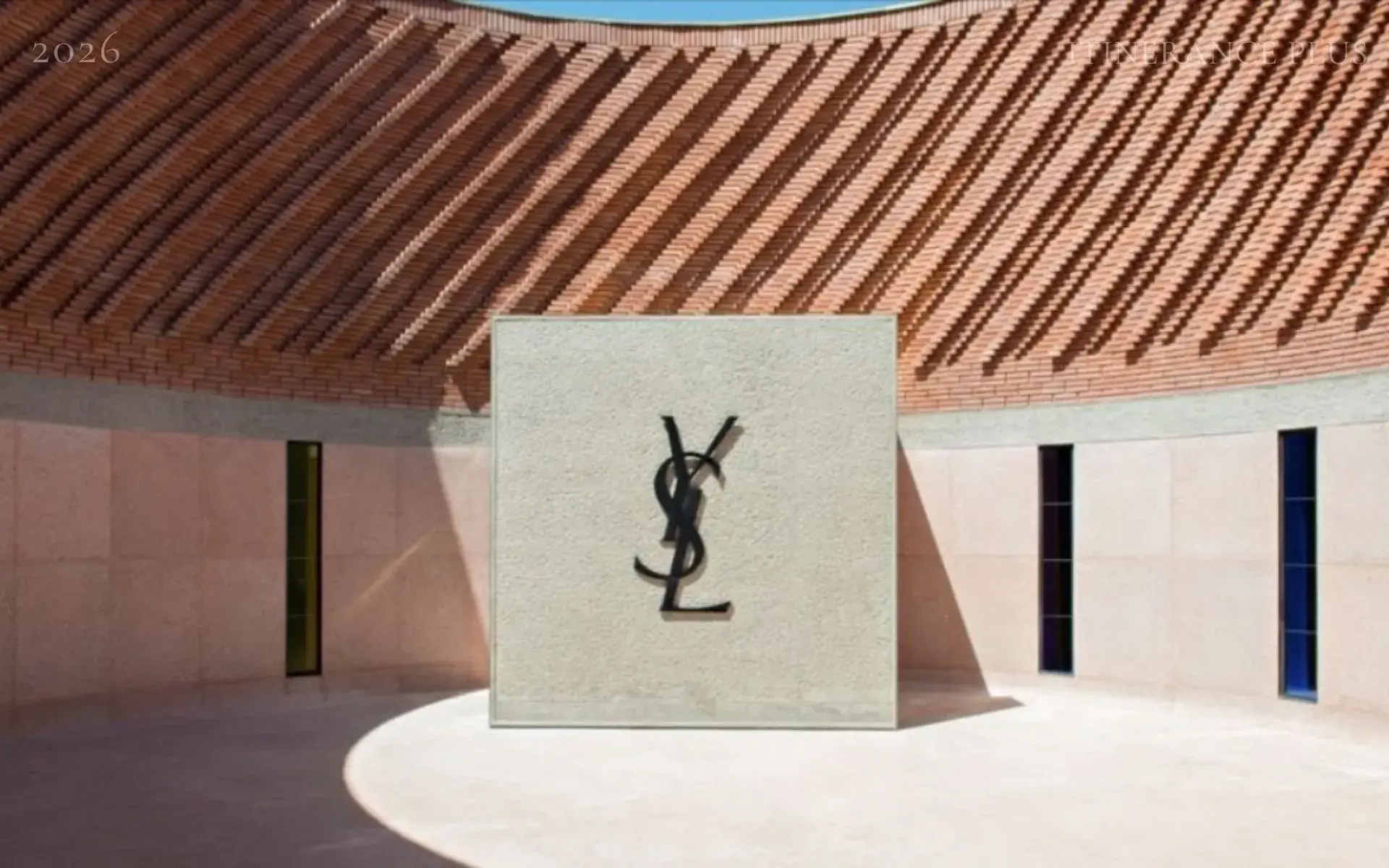
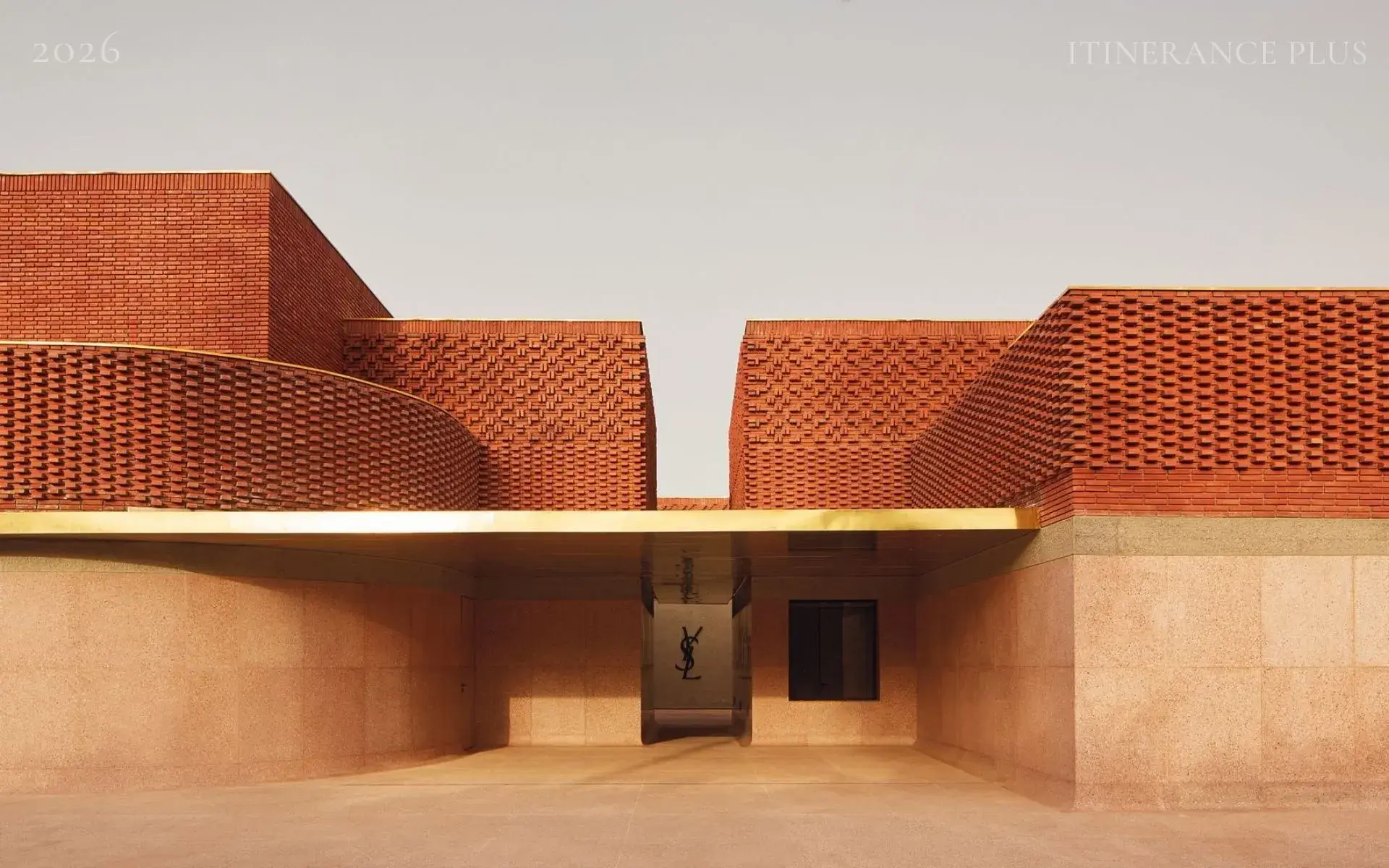
Key takeThe harsh midday light hits the terracotta walls, creating a play of shadows that seems to imitate the weave of a precious fabric.
Under your fingers, the deep red brick, arranged in lace patterns by the Studio KO firm, offers a grainy and warm texture, an architectural signature that dialogues with the ocher of the Medina ramparts.
You haven't even entered yet, but the building already imposes a respectful silence, a clear break from the bustle of the blue taxis parading on Yves Saint Laurent Street.
The smell of dry dust here mingles with a sudden freshness, that of a circular patio where the Marrakesh sky seems to rush in like a well of pure light.
The Yves Saint Laurent Museum Marrakesh does not just house dresses; it embodies this mystical encounter between Parisian haute couture and Moroccan earth.
Crossing the threshold, you feel the transition from overwhelming heat to a hushed, almost sacred atmosphere, where the echoes of footsteps on the polished floor are the only sounds that dare disturb the tranquility of the place.
It is here, in this Guéliz district, that the creator's soul found its definitive refuge, far from the agitation of the catwalks but closest to his primary source of inspiration.
Location
Insight
First impressions
The harsh midday light hits the terracotta walls, creating a play of shadows that seems to imitate the weave of a precious fabric.
Under your fingers, the deep red brick, arranged in lace patterns by the Studio KO firm, offers a grainy and warm texture, an architectural signature that dialogues with the ocher of the Medina ramparts.
You haven't even entered yet, but the building already imposes a respectful silence, a clear break from the bustle of the blue taxis parading on Yves Saint Laurent Street.
The smell of dry dust here mingles with a sudden freshness, that of a circular patio where the Marrakesh sky seems to rush in like a well of pure light.
The Yves Saint Laurent Museum Marrakesh does not just house dresses; it embodies this mystical encounter between Parisian haute couture and Moroccan earth.
Crossing the threshold, you feel the transition from overwhelming heat to a hushed, almost sacred atmosphere, where the echoes of footsteps on the polished floor are the only sounds that dare disturb the tranquility of the place.
It is here, in this Guéliz district, that the creator's soul found its definitive refuge, far from the agitation of the catwalks but closest to his primary source of inspiration.
Architecture
Why is the architecture of the Yves Saint Laurent Museum Marrakesh a work in itself?
One cannot understand this sanctuary without lingering over its brick skin. The architects designed a structure that borrows as much from modernism as from the traditional techniques of the country.
The exterior facade, with its curves and straight lines, evokes the flexibility of a drape or the rigor of a sewing pattern. The Moroccan brick, made from Al Haouz earth, is here repurposed from its utilitarian use to become a textile ornament.
As you approach, you observe the precision of the arrangements: relief blocks alternate with smooth surfaces, creating a visual vibration that changes with the angle of the sun.
It is an architecture that breathes, absorbing light to better diffuse it, protecting the fragile treasures it contains from the assaults of the region's arid climate.
Inside, the contrast is striking. The brick gives way to a black setting, smooth and shiny like satin. This choice is not accidental; it allows the walls to disappear so that only the colors of the clothes vibrate.
The tour is a fluid stroll, an immersion in darkness where spotlights isolate each collection piece like an apparition. One passes from one room to another without ever feeling oppressed, guided by a staging that prioritizes visual emotion.
The building itself acts as a protective armor for the silk, velvet, and muslin fabrics that fear ultraviolet rays.
It is an aesthetic safe where every detail, from the door handle to the grain of the terrazzo, has been designed to honor the couturier's legacy.
The circular courtyard, with its monumental logo inlaid in stone, serves as a central pivot. It is a breathing space where you can look up toward the azure blue, framed by ocher brick.
This opening to the outside reminds us that the Yves Saint Laurent Museum Marrakesh is not a closed place, but an extension of the urban landscape. It integrates into the neighborhood with a humility that hides great technical complexity.
Walking through the corridors, you feel this harmony between the raw and the precious, a duality that already inhabited Yves Saint Laurent's collections.
Architecture here becomes the language through which France and Morocco speak to each other, without artifice, with the simplicity of the right gesture and true material.
Insight
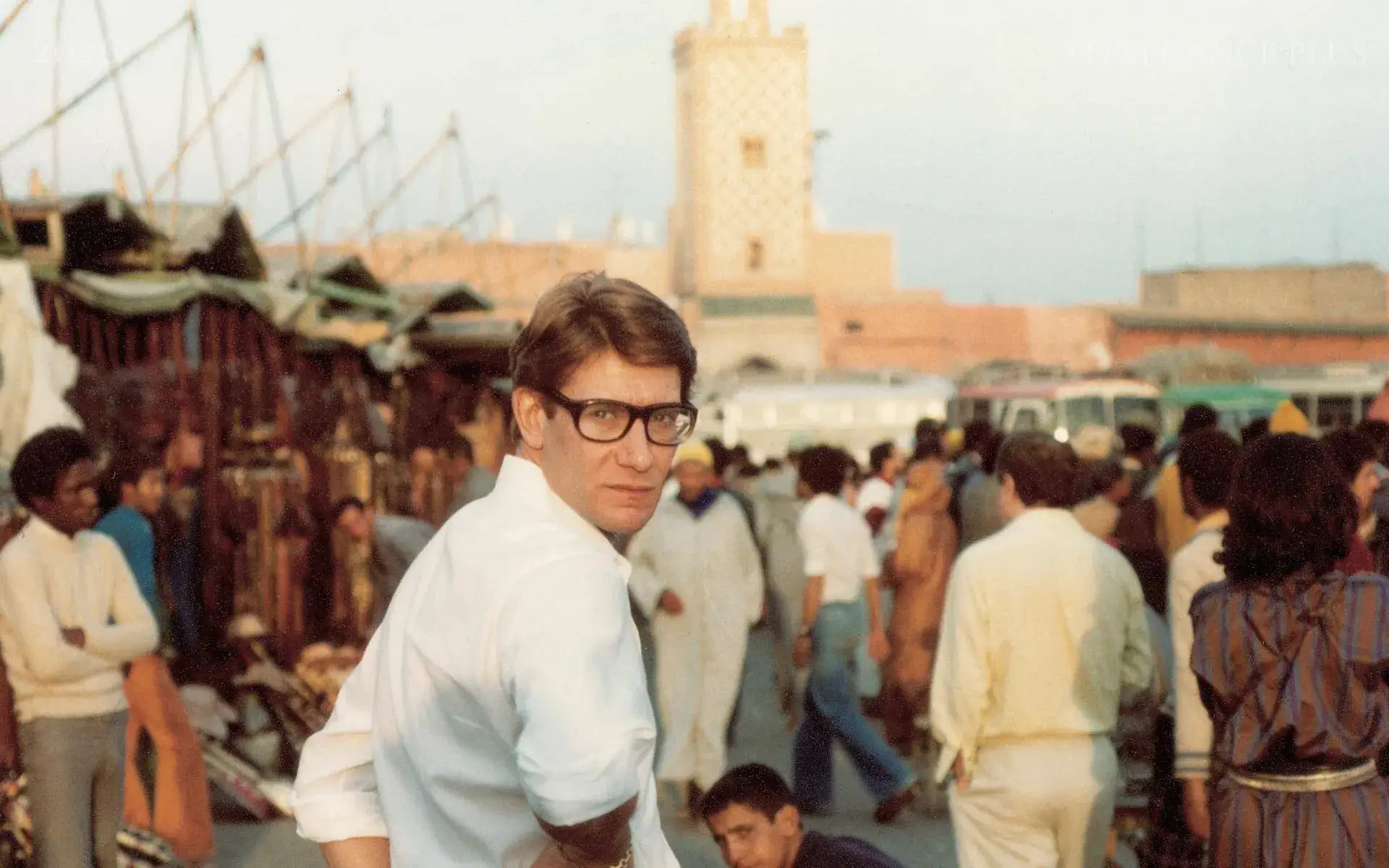
How do the permanent collections tell of a dreamed Morocco?
The heart of the visit lies in the large exhibition hall where the creator's iconic pieces are presented. Here, the garment is no longer a utilitarian object; it becomes a living sculpture.
You discover how the traditional burnous of the Atlas Mountains transformed into a haute couture cape, or how Berber embroideries inspired jackets of extreme sophistication.
Color, omnipresent, bursts in the darkness of the room: fuchsia pinks, saffron oranges, emerald greens that seem to have been stolen from the stalls of the spice souk.
One then understands the couturier's famous sentence claiming that Marrakesh had taught him color, he who until then had only used the black and white of his debut at Dior.
The exhibition does not follow a boring chronological order but is organized around themes that haunted the master's mind. Travel, Africa, the imaginary Orient, the garden—all stations that allow one to grasp the depth of his creative process.
You see up close the texture of the fabrics, the finesse of a jet button, the precision of a cut that frees the woman's body. Each piece is accompanied by sound and visual archives that place the garment back in its creative context.
One hears the rustle of fabrics during past fashion shows; one catches glimpses of sketches thrown onto paper with a nervous hand. Morocco is not a simple decorative theme here; it is the very essence of the structure of the collections.
Observing the massive jewelry and accessories that punctuate the tour, you realize how much local craftsmanship has irrigated world fashion. The geometric shapes of Anti-Atlas ornaments are found stylized in resin or metal necklaces.
This dialogue between the ancestral know-how of the Southern tribes and the demand of Parisian luxury creates a fascinating aesthetic tension.
The Yves Saint Laurent Museum Marrakesh succeeds in showing that fashion can be a bridge between cultures, a silent conversation between the hands that weave wool in villages and those that sew silk in the workshops of the Latin Quarter.
It is an ode to diversity, respectful borrowing, and the permanent reinvention of self through the eyes of the other.
Insight
What role does the research library play in this place of memory?
Few visitors venture toward the library, yet it constitutes one of the most moving spaces in the estate.
It is a place of silent study, where thousands of works on fashion, Berber arts, literature, and the history of Morocco are made available to researchers and enthusiasts.
The smell of old paper and leather bindings creates a modern cabinet of curiosities atmosphere. There are rare editions, auction catalogs, and personal books that belonged to Yves Saint Laurent and Pierre Bergé.
It is the living memory of their shared passion for culture and knowledge, an intellectual extension of the sensory experience of the exhibition halls.
The shelves rise to the ceiling, offering a perspective on the diversity of sources that nourished the couturier's imagination.
You can consult works on Andalusian architecture or natural dyeing techniques, thus understanding that every dress is the result of a sedimentation of knowledge.
The library highlights Pierre Bergé's desire to make this museum not a frozen mausoleum, but an active research center. It is a space where time stops, conducive to reflection, far from the tourist bustle of the Majorelle Gardens located just steps away.
The light there is soft, filtered by drapes that protect precious bindings from Marrakesh's brilliant clarity.
Working or simply sitting in this space allows one to become aware of the intellectual demand surrounding fashion creation. One does not create from nothing; one creates from a culture, a history, and a heritage.
The Yves Saint Laurent Museum Marrakesh fully assumes this educational dimension. Leaving the library, your view of the exhibited clothes has changed.
You now see the literary influences, the pictorial references, and the immense respect for the founding texts of Moroccan culture.
It is a stage that gives depth to the visit, transforming a simple aesthetic walk into a journey of the mind through books and eras.
Insight
How does the temporary exhibition hall renew interest in the site?
The institution's dynamism relies heavily on its temporary programming. These exhibitions, which change regularly, allow for the exploration of little-known facets of contemporary art or traditional craftsmanship.
Sometimes it is a photographer who captured the couturier's intimacy who is honored; other times, it is a dive into the costumes of a remote region of the country.
This alternation ensures that the place remains alive, in touch with current creation. You discover local artists whose work resonates with the museum's aesthetic, creating unexpected bridges between past and present.
The scenography of these exhibitions is always very rigorous. It uses the space with a freedom that contrasts with the fixity of the permanent collection.
There are multimedia installations, projections, or bold stagings that shake up the usual codes of fashion exhibition. This is where the Yves Saint Laurent Museum Marrakesh confronts the city's raw modernity, its questions, and its mutations.
The themes addressed are often related to identity, the body, and transmission—subjects that were dear to Yves Saint Laurent throughout his life.
Visiting this section, one understands that the creator's legacy is a plastic material, capable of inspiring new generations of artists.
The programming is designed to surprise, to provoke an emotion different from that sparked by the famous tuxedos or Mondrian dresses. It is a space of freedom where one can see Morocco through new eyes, far from Orientalist clichés.
Whether through painting, sculpture, or video, the art exhibited here testifies to the vitality of the Marrakesh cultural scene, a city that continues to fascinate and attract creators from all over the world, exactly as it did for Yves Saint Laurent in 1966.
Atmosphere
What atmosphere does the Studio Café offer during a contemplative break?
After the visual intensity of the galleries, the Studio Café offers a welcome haven of peace. Its name refers to the creation studio on Avenue Marceau, but the atmosphere is resolutely Moroccan.
The decoration is sober, with touches of saffron yellow and green that recall the Jardin Majorelle palette. Large glass doors open onto a linear pool where water slides with a soothing murmur.
You can sit inside or on the shaded terrace to enjoy light cuisine that marries local flavors and French classics. The café then becomes the natural extension of the visit, a place where one digests the impressions accumulated among the dresses and sketches.
The menu offers specialties such as carrot salads with orange blossom, fine quiches, or delicate pastries. One drinks elegantly served mint tea or a strong coffee while observing the ballet of visitors in the courtyard.
The atmosphere is calm, conducive to confidences or reading. It is a rare luxury in a city as noisy as Marrakesh to find such silence in the middle of the day.
The staff, discreet and attentive, participates in this feeling of privilege. One is not in an ordinary museum café; one is in a tea room that could have been that of the couturier himself, welcoming his visiting friends.
The Studio Café is also the ideal place to observe architectural details from another angle. From your table, you can admire the play of shadows on the brick walls and the precision of the finishes.
Here, you feel protected from the outside world, wrapped in a bubble of good taste and serenity. It is the time to take out your travel diary, note your emotions, or reread passages from an exhibition catalog.
The café closes the visit on a note of sweetness, confirming that the Yves Saint Laurent Museum Marrakesh is a total experience, addressing the intellect as much as the senses and physical well-being.
Insight
Why is the Pierre Bergé Auditorium a major cultural hub?
Best time to visit: The transitional months like October, November, March, and April are perfect for enjoying the soft light without suffering from the summer heat. The morning at opening allows you to avoid groups and savor the silence of the galleries.
Average daily budget: The entry ticket costs about 130 Dirhams (approximately 12 Euros). If you also wish to visit the Jardin Majorelle and the Pierre Bergé Museum of Berber Arts, combined tickets are available for around 300 Dirhams. Plan an extra amount for a gourmet break at the Studio Café.
How to get there: The museum is located on Yves Saint Laurent Street, right next to the Jardin Majorelle, in the Guéliz district. You can easily access it by small taxi from the Medina or on foot if you are staying in the new city.
Ideal length of stay: Devote at least two hours to visiting the galleries and the library, plus an additional hour to enjoy the temporary exhibition and a moment of relaxation at the café.
Frequently asked questions
Everything about Le Musée Yves Saint Laurent Marrakech : l'élégance de la brique
Other places to discover
More places to explore nearby
Garden
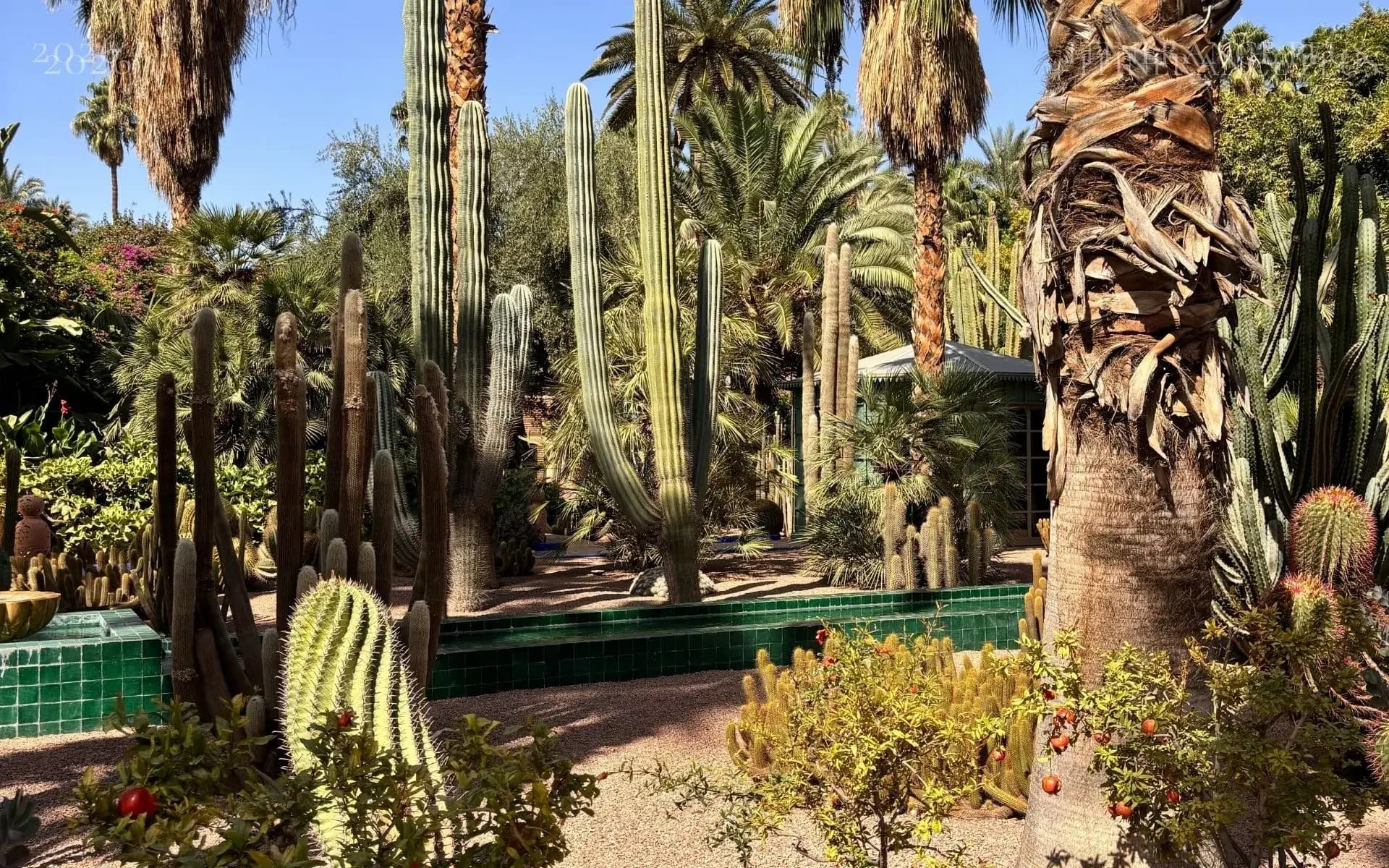
Majorelle Garden: an immersion in the cobalt blue of Marrakech
A sanctuary of freshness and color in the heart of Guéliz, where rare botany, Yves Saint Laurent's legacy and precise light meet.
Square
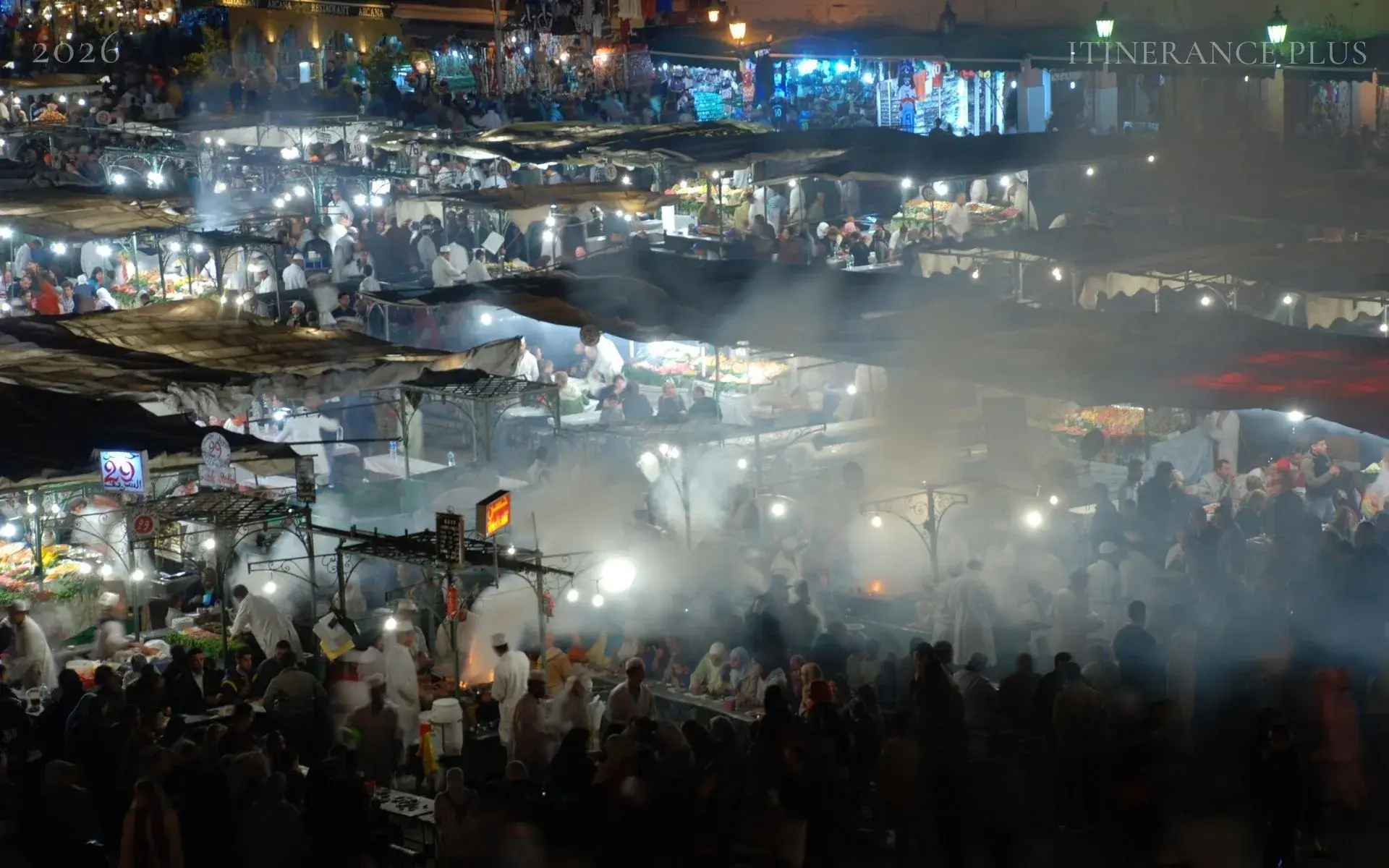
Jemaa el-Fna: diving into the vertigo of Marrakech
The smell of cedarwood smoke mixes with the scent of freshly pressed oranges, creating a dense, almost tangible atmosphere. In the distance, the first Maghreb call to prayer rises, filtered through the minarets of the...
Practical guides
Useful guides around this place
These guides help compare rhythms, formats and practical choices before shaping the visit.


Related experiences